What Is 3D Animation? Skills, Process and Career Opportunities
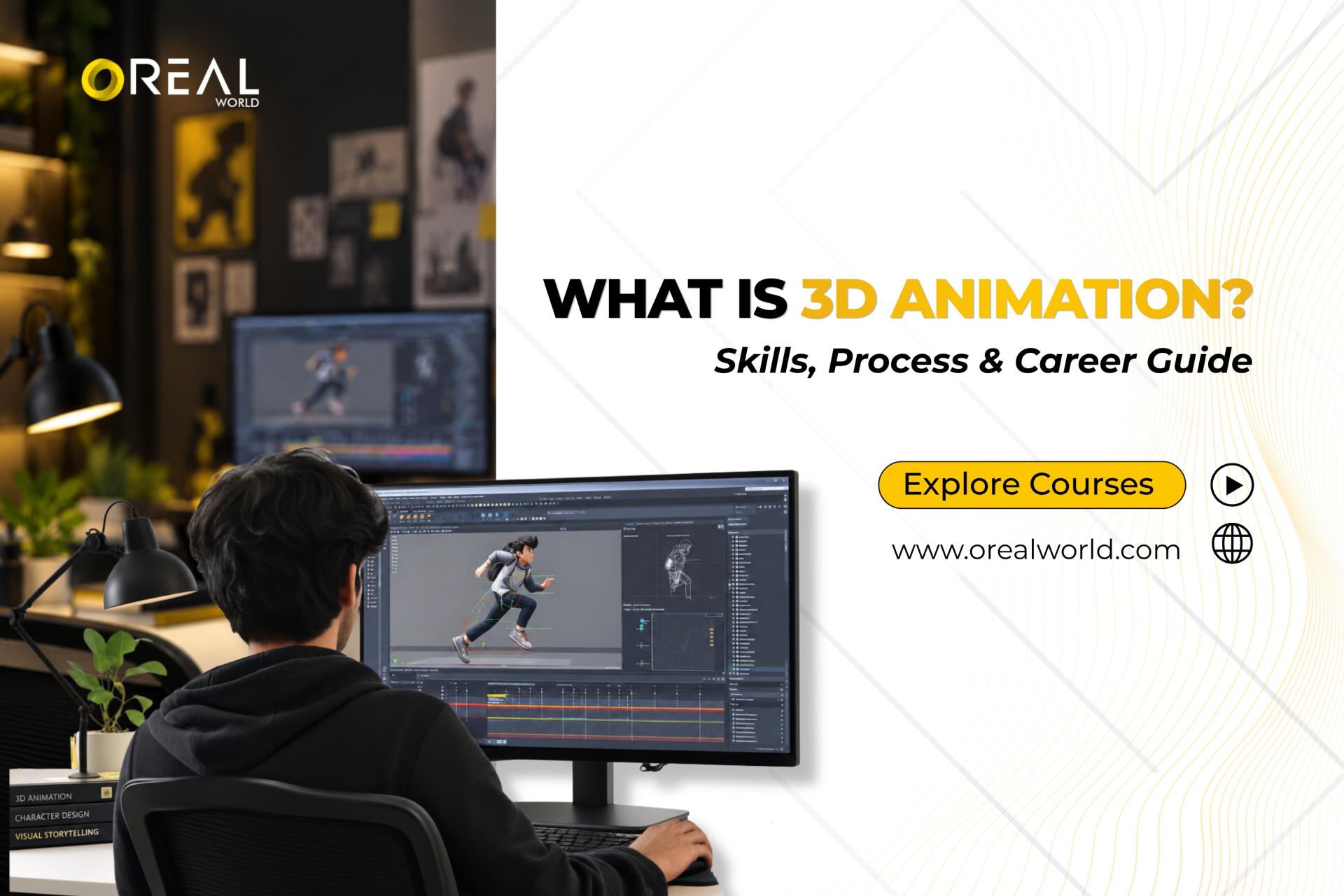
Learn what 3D animation is, how the process works, essential skills, software, career options and how to choose a 3D animation course after 12th.
3D animation is utilized in film and television, video games, advertising, special effects, architecture, and many other fields. It is an effective method to depict ideas and concepts that are difficult, if not impossible, to portray in the physical world. With the evolution of computing and graphics technology, it has become increasingly easier to create photo-realistic virtual environments.
Although 3D animation is widely used in the entertainment and technology industries, it can be difficult to learn. There are many different pieces of software that facilitate the process, however, creating quality animations requires an understanding of concepts such as motion, timing, and performance, as well as an understanding of the various techniques used in film making and entertainment. Ultimately, the goal of any animated production is to narrate a story.
A good 3D animation course will introduce students to this entire process through practical projects. Before choosing a course, however, it is important to understand the different aspects of 3D animation, its production cycle, valuable skills, as well as what career opportunities a 3D animator can expect to have.
What 3D Animation Actually Is?
3D animation is the process of creating movement in digitally created three-dimensional objects, characters, environments, or scenes.
But animation is more than making those 3D assets move.
For example, a bouncing ball is an indication of weight. A character walking can be nervous or tired or confident or surprised-or a dozen other emotions-before it says a word.
That is where timing, spacing, observation, and performance come in.
Creating movement is not the only purpose of 3D animation. It is also used to represent an idea and move things as in the real world.
3D Animation vs. 3D Modeling
The words animation and modeling are often confused.
A model in 3D is like a blueprint of a character or object showing its physical characteristics and design.
On the other hand, animation is the process of designing and producing movement for characters, objects and various elements in 3D.
An animator will use software to bring to life a 3D model, for example, to show a character’s emotion by changing the position of the eyes or to make the character run by moving its legs.
Often the same people will do both modeling and animation for a project. However, they are completely different and separate from each other.
Where 3D Animation Fits in the Larger Workflow
3D animation is one part of a larger production pipeline. A typical workflow can include:
Modeling
Texturing
Rigging
Animation
Lighting
Rendering
Compositing and editing
Each stage contributes to the final result. Depending on the project, an animator may receive a model that has already been created and rigged before beginning the animation process.
The 3D Animation Process
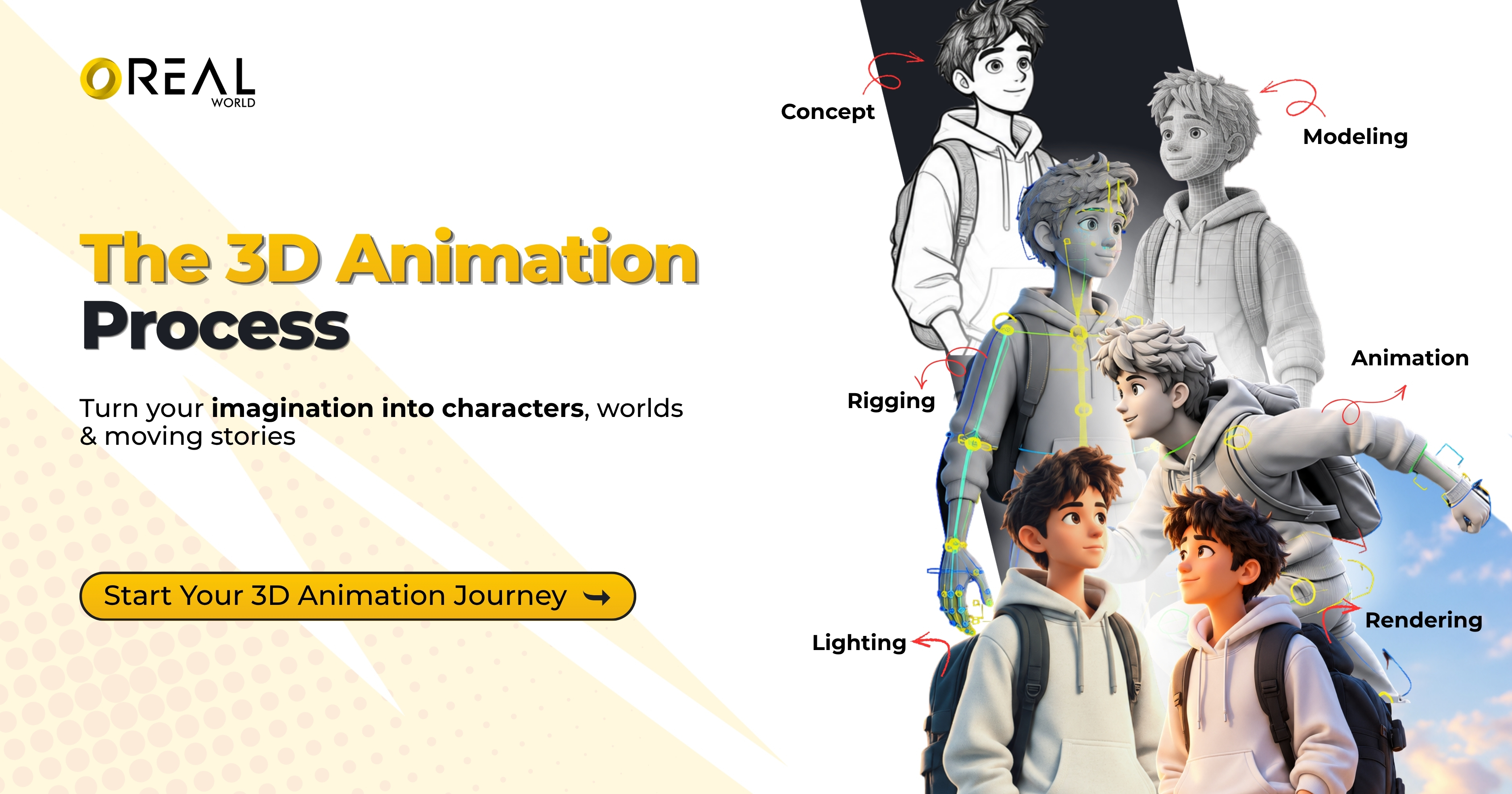
A final animated scene can appear to be simple, but it generally involves a number of different phases before the final product is formed.
1. Planning the Action and Visual Direction
Before the animators start working, the team has to understand the requirements that they have to meet.
Using storyboards, reference videos, character descriptions, camera instructions, and visual aids can assist the team in understanding the animation’s action and direction.
The proper planning allows the animator to have a clear vision of what they have to make the character or object perform and why it has to be realized in specific ways.
2. Building the Digital Form
You will learn 3D modeling in this step.
3D digital assets (characters, props, sets, etc.) are created by constructing digital geometry with 3D modeling software.
3D artists design and build 3D geometry based on the concepts and assets that illustrate the ideas and stories that are represented in a game, animation, film, and other visual media.
At this stage, the emphasis is placed on the creation of form and structure rather than animation and surface details.
3. Giving the Surface Its Look
A newly created 3D model may initially look plain or grey.
Texturing and materials add visual detail to the surface. Artists can define elements such as skin, fabric, wood, metal, plastic, dirt, scratches, and other surface properties.
Materials also determine how a surface responds to light. This helps make objects look more realistic or achieve a specific artistic style.
4. Preparing the Model for Movement
Rigging prepares a model for animation.
A digital skeleton and a collection of controls are created so that the animator can move different parts of a character or object.
Good rigging is important because it allows movement to happen in a controlled and believable way. Poor rigging results in unnatural bends, broken joints, and difficult animation workflows.
5. Creating Movement and Performance
This stage focuses on creating movement and performance.
Animators set key poses at important points in the sequence, while the software creates the movement between them.
However, software does not decide what makes a movement feel heavy, loose, energetic, nervous, or dramatic.
These are choices the animator is making.
An animation made up of good timing, spacing, body mechanics, weight, expressions and movement feels believable.
People are usually aware of the illusion of movement, and believe the movement to be real. This creates a believable animation.
Animations executed well usually contain a sense of weight. Weight can be effective in comedy by lessening the impact of a fall.
6. Shaping the Shot With Camera and Light
What the audience sees in an animated scene depends upon the camera and lighting.
The use of different camera set ups, compositions and lighting all contribute to creating different looks for animated scenes. Something as simple as where the camera is placed can affect where the viewer looks. The use of light can help define how far things are from each other in the scene, the overall feeling of the scene and how clear or distracting things are in the scene.
7. Turning the Scene Into the Final Visual
The completed 3D scene is then rendered into the final image or image series.
Compositing and editing of the image can then take place, depending on the project. A variety of visual elements can be incorporated, effects can be added, and shots can be compiled into the final video or sequence.
The Actual Important Skills for 3D Animation
A working knowledge of animation software is important, but it is not the sum total of what makes a great animator.
Some of the most vital 3D animation skills are as follows:
Observation: Animators have to see the way humans, animals, and objects move. Having a good sense of weight and balance will help one create very realistic animation.
Timing and Spacing: These are the principles of animation that determine how long an action is drawn out, and how an object or character is positioned relative to other positions. Both principles are used to add realism and variation to animation.
Understanding 3D space: the animator must have an understanding of the position, rotation, depth, perspective, and relation of things in the environment.
Creative and technical thinking: Animation requires a combination of art and technical skills. The software can help animators, but there is a need to solve various problems related to the scene, rig, file, or software.
Communication and teamwork: There is usually a team of people involved in 3D production, and animators play a major role. The animation process requires cooperation with other team members such as a modeller, rigger, lighting artist, VFX artist, director, designer, and many others.
Do You Need Strong Drawing Skills?
Not necessarily.
Drawing helps to build understanding of proportion, gesture, composition, etc. But to be a 3D animator, you don't strictly need to have traditional drawing skills.
It's more important to understand how to perform movements, poses, timing, and proportions in 3D.
People can develop their understanding of movement through observation and different kinds of activities (athletics, ballet, acting, etc.)
Software Behind a 3D Animation Workflow
Different stages of a 3D production pipeline can use different software.
Autodesk Maya is the industry-standard software for 3D modeling, skeletal and virtual animation and other related activities.
Blender is equally good and is free to download and use by everyone. Among its features, Blender is good for 3D modeling, animation and rendering.
ZBrush is a digital sculpting tool mainly used for detailed sculpting and character creation.
Substance 3D Painter is preferred to create and paint 3D assets in detail.
Unreal Engine is becoming more prominent in the realm of real-time 3D, games, virtual production, and immersive experiences. Game development with Unreal Engine can also offer students an insight into real-time 3D pipelines.
You do not need to be an expert in all the programs mentioned above. It is essential to highlight that depending on the desired career path, one might choose one software over others.
Where 3D Animation Is Used
3D animation is no longer limited to animated films.
It is used in:
Film and streaming content
Games and interactive experiences
Advertising and product visualisation
VFX and virtual production
Architecture and real-estate visualisation
Education and training
AR and VR experiences
Product demonstrations
Digital marketing and branded content
For example, a furniture company could take advantage of 3D animation to display different variations of the product, such as colors or backgrounds, without physically making all these options.
This versatility of the application of 3D technology encourages students to consider a range of industries in which they would be interested in pursuing their careers.
Career Roles in 3D Animation
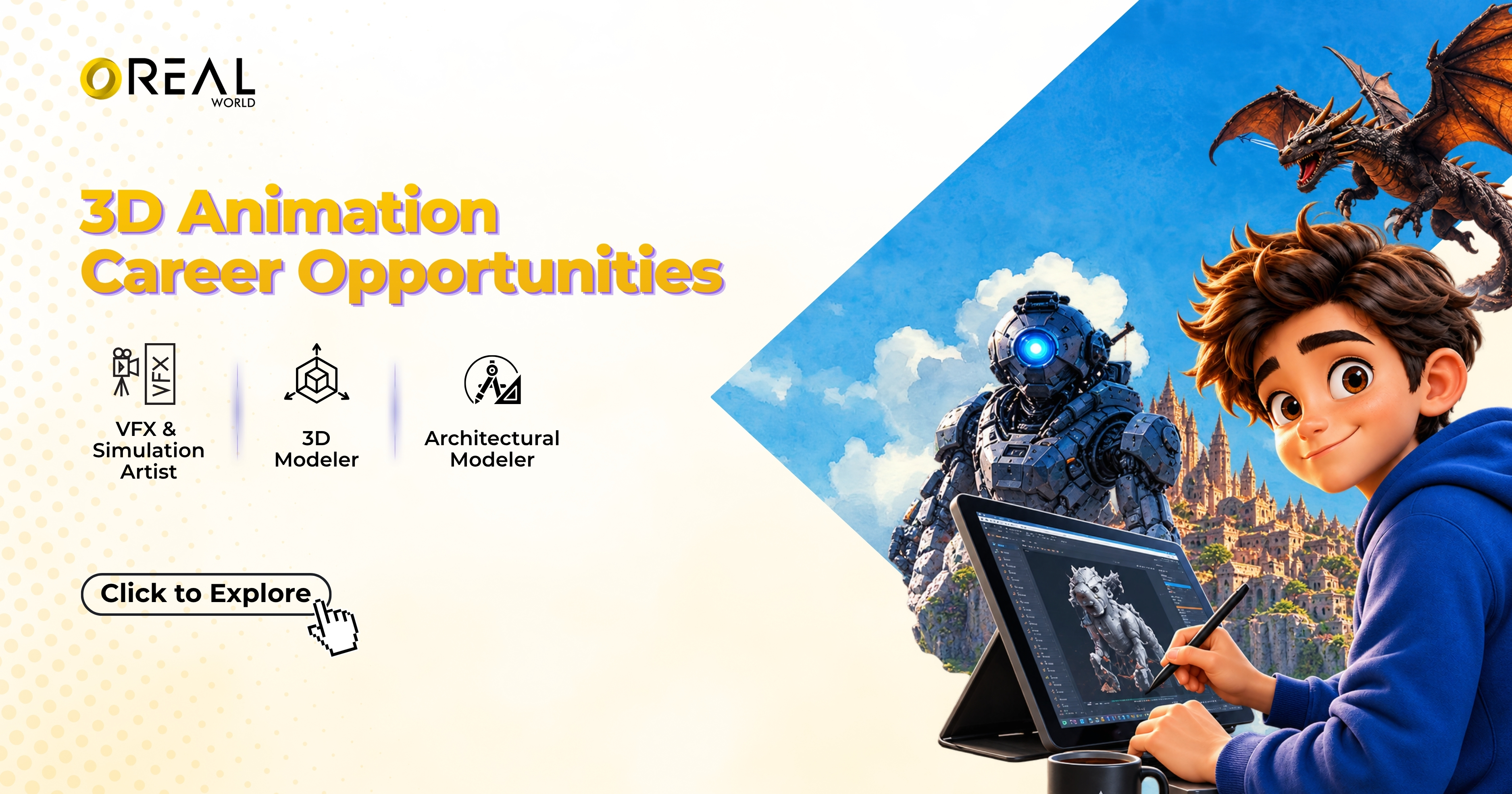
If you have learnt 3D animation, it doesn’t mean that you’ll just work as a 3D animator. There are several other professional roles you can work in.
3D Animator
Creates animation and performance for characters, objects, and other elements in a scene.
3D Modeler
Creates digital characters, props, products, and environments.
Character Artist
Designs and sculpts 3D characters, including anatomy and facial features and different clothing styles.
Rigging Artist
Creates digital skeletons and controls that allow characters and other objects to be animated.
Texture and Look Development Artist
Works on surface appearance, materials, colors, and how light interacts with objects, making them look realistic.
Lighting Artist
Responsible for setting up scenes using lights and other means to set the mood, depth, and color of an image.
Real Time 3D/VFX Artist
Creates simulations, visual effects, and real-time 3D and 2D graphics.
Need Help Deciding Which 3D Path Is Right For You?
Your interests can give you an idea of which specialisation may suit you.
If you enjoy | You could explore |
Movement and acting | 3D Animation |
Building digital forms | 3D Modeling |
Characters and anatomy | Character Art |
Technical problem-solving | Rigging |
Materials and surface details | Texturing |
Cinematography and mood | Lighting |
Effects and simulations | VFX |
Before deciding on your specialisation, make sure you explore different areas. This would help to choose the right option for you.
Is It Possible To Learn 3D Animation After Class 12?
Yes, learning 3D animation can be taken up after class 12.
In terms of experience in other 3D software and drawing, the interest of a learner in animation and eagerness to create a story is more valuable.
This creativity and interest, if coupled with training and practice, can turn a learner into a budding animator.
While searching for the best 3D animation course after 12th, students must look beyond the list of software that the institute provides. A good programme should offer exposure to the entire production pipeline, practical assignments, and help build a portfolio while receiving feedback.
Students who wish to join a 3D animation course in Noida should do a comparison of curriculum, practical training, project work, software used, and portfolio creation before choosing any animation course.
What to Expect When Looking for a 3D Animation Course?
The proper course sets the path towards your learning.
The first week will inform you about the company and how the course is run. It will also give you an overview of what will be expected over the next ten weeks.
When choosing a course, ensure that the course includes subjects like:
3D modeling
Texturing and materials
Rigging
Character animation
Lighting and rendering
Animation principles
Industry-standard software
Practical projects
Portfolio or showreel development
Feedback and mentorship
Production-oriented workflows
A good course should enable you to understand why it works, instead of just teaching you what buttons to press in one particular package.
Moving From Learning to a 3D Animation Career
Software learning is just a part of the process. In order to become a 3D animator, one must practice and enhance one's skills.
Build Your Fundamentals
Understand the basic concepts of motion, timing, spacing, anatomy, shape, physics, and storytelling applicable to your intended job position.
Explore Different Areas
Try your hand at modeling, rigging, animating, texturing, and lighting, or any other stage of production that may interest you.
Learn Relevant Software
It is important to learn the software according to the position that one wants to acquire, instead of learning all available software.
Practise Through Projects
While tutorial videos can teach how to use the software, projects will enable one to gain decision-making and problem-solving skills.
Build a Portfolio or Showreel
This will give potential clients or employers a glimpse of what one can produce.
Gain Production Experience
Internships, working as a freelancer, projects, collaborations, and working in a studio, among others, will provide insight into the production process of 3D animation.
Is 3D Animation a Good Career in India?
3D art and design are emerging careers that combine creative and technical skills.
Animation can be transferred to various fields including film, television and video games, advertising, architecture, teaching, and virtual reality.
Working in 3D animation and design has many challenges. Artists work on detail-oriented tasks and must take multiple revisions of a project. Deadlines and criticism from other artists are unavoidable. Artists must be patient, persistent and flexible while working in this field.
The career growth of someone depends on the specialisations, skills, portfolio, and the types of projects one works on, related to the industry of one's preference.
Are you a good fit for 3D Animation?
If you like any of these things, then 3D animation is likely a good choice for you:
Visually constructing stories
Creativity combined with technology
Movement and performance
Digital art and design
Problem-solving
Detailed project work
How to learn new software
If you like planning, problem solving, creativity and co-operation, check out 3D animation.
The best way to do this, is to try it out and see what option best fits you.
Commonly Asked Questions For 3D Animation
Is 3D animation hard to learn?
3D animation takes time and regular practice to learn. The learning period varies depending on your goals, prior experience, software skills, and the amount of practice you put in. Beginners typically start by learning the fundamentals of 3D software and animation principles before developing more advanced skills such as character performance, acting, and production workflows.
Can I learn 3D animation without being able to draw?
While it definitely helps to understand basic proportions and movements with drawing, you don't need to be able to draw well to be a 3D animator. You don't even need to know how to draw to be a 3D animator.
What is the difference between a 3D modeler and a 3D animator?
A modeler and an animator are two separate jobs. A modeler creates and shapes a 3D object, and then a 3D animator puts movement in the 3D object.
Which program should I use if I want to learn 3D animation?
Blender is actually really good to use if you just want to learn the basics and get the hang of 3D animation and other related fields. For other more specialized programs, like Maya, you may want to look elsewhere.
What are the careers I can get after learning 3D animation?
There are plenty of career paths you can take like a 3D animator, 3D character animator, 3D modeler, 3D character artist, rigging artist, etc.
How long does it take to learn 3D animation?
It really differs from person to person. Some find it easier to pick up the animation elements and others find it easier to learn the technology side of it. The length also depends on how dedicated and determined you are. The basics of the programs are easier to learn but a career in animation requires a lot of hard work, and time.
3D animation after 12th?
A lot of students these days take a keen interest in visual effects, video games and cinematics. 3D animation provides a career pathway in all of these fields. Students are encouraged to build their portfolios as it increases their chances of employment.
Is there work for 3D artists outside films?
Yes there are multiple fields including games, architecture, advertising and even education.
Final Thoughts
3D animation is a fusion of multiple disciplines. From a viewer’s perspective, an animated sequence may last a few seconds. Behind the scenes, numerous aspects of planning, modeling, rigging, animating, and post-production go into that sequence.
You aren’t required to understand and master each of these aspects to venture into 3D animation. First, familiarize yourself with the foundation, and then explore other aspects that complement your interests.
In the field of 3D animation, if character acting is your primary interest, OREAL World offers an extensive 3D Animation program where you can learn practical skills to help build a career in this field.
Frequently Asked Questions
Is 3D animation hard to learn?
3D animation takes time and regular practice to learn. The learning period varies depending on your goals, prior experience, software skills, and the amount of practice you put in. Beginners typically start by learning the fundamentals of 3D software and animation principles before developing more advanced skills such as character performance, acting, and production workflows.
Can I learn 3D animation without being able to draw?
While it definitely helps to understand basic proportions and movements with drawing, you don't need to be able to draw well to be a 3D animator. You don't even need to know how to draw to be a 3D animator.
What is the difference between a 3D modeler and a 3D animator?
A modeler and an animator are two separate jobs. A modeler creates and shapes a 3D object, and then a 3D animator puts movement in the 3D object.
Which program should I use if I want to learn 3D animation?
Blender is actually really good to use if you just want to learn the basics and get the hang of 3D animation and other related fields. For other more specialized programs, like Maya, you may want to look elsewhere.
What are the careers I can get after learning 3D animation?
There are plenty of career paths you can take like a 3D animator, 3D character animator, 3D modeler, 3D character artist, rigging artist, etc.
How long does it take to learn 3D animation?
It really differs from person to person. Some find it easier to pick up the animation elements and others find it easier to learn the technology side of it. The length also depends on how dedicated and determined you are. The basics of the programs are easier to learn but a career in animation requires a lot of hard work, and time.
3D animation after 12th?
A lot of students these days take a keen interest in visual effects, video games and cinematics. 3D animation provides a career pathway in all of these fields. Students are encouraged to build their portfolios as it increases their chances of employment.
Is there work for 3D artists outside films?
Yes there are multiple fields including games, architecture, advertising and even education.