How Can You Start a VFX Career After 12th?
Learn how to start a VFX career after 12th, explore VFX courses, specialisations, skills, software, portfolio tips, jobs, and career opportunities.
If you are looking for a VFX course after 12th, you can choose from certificate, diploma, and degree programmes based on your interests and career goals. Various certification, diploma and degree courses are available in VFX. Through these courses, you learn various aspects of VFX such as 3D modeling, compositing, lighting, match moving, FX and other areas of VFX.
How you choose the right path depends upon the kind of VFX work you like doing, the course you choose, and the portfolio that you’ll build while training.
This guide discusses VFX courses after 12th, specialisations, skills, software, building a portfolio, job roles, and selecting a VFX institute.
Students have different VFX courses options after class 12. These courses have varying levels of higher education, from undergraduate and postgraduate certificates, diplomas and degrees.
What Does a VFX Career Involve?
VFX, also known as visual effects, refers to the combination of live-action footage with CGI and other digital elements. These elements help to create those shots that look impossible to create on camera.
For example, a sequence where Spider-Man swings and leaps from building to building. The digital environment is created through 3D modelling of the objects. The camera movement is tracked, and effects are added and combined with the live footage.
A VFX artist rarely does everything. Rotoscoping, matchmoving, compositing, 3D modelling, lighting, FX, pick one, maybe two, and that becomes your lane.
Now, VFX gets mixed up with animation and motion graphics a lot, so here's the actual difference.
VFX starts with real footage and adds digital elements to it.
Animation skips the real footage part entirely; everything's built from scratch.
Motion graphics are text, shapes, and visuals stitched together to communicate something specific.
Overlap exists. The jobs still aren't interchangeable.
Which VFX Specialisation Can You Choose?
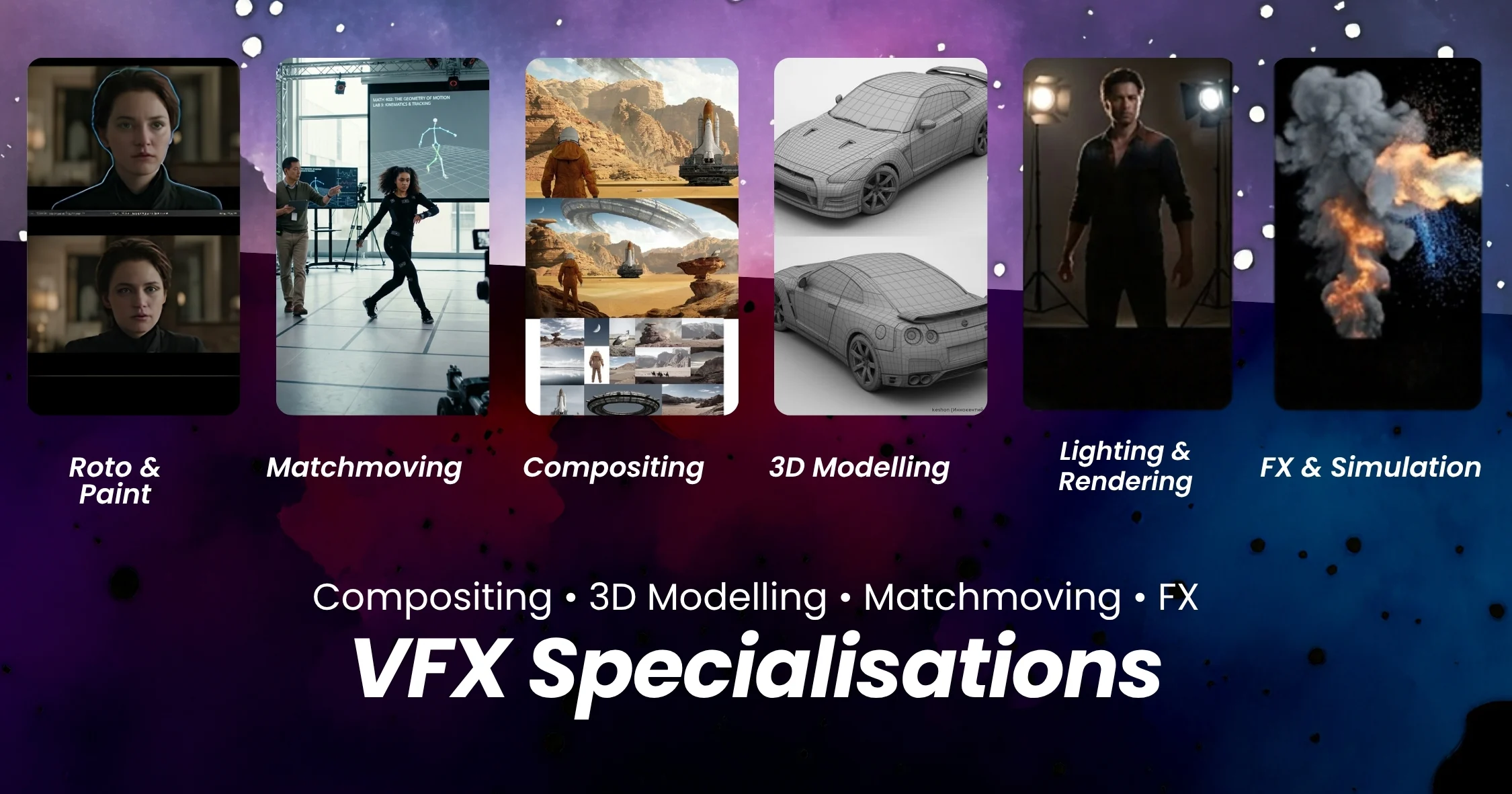
You won’t have to pick a specialisation before starting to learn. You can later try different types of projects to understand in which area of VFX workflow you can contribute the most.
Specialisation | What You Work On | Useful Skills |
Roto & Paint | Isolating, removing, or cleaning elements in footage | Patience, precision, attention to detail |
Matchmoving | Tracking camera and object movement in 3D | Technical thinking, problem-solving |
Compositing | Combining live footage with CGI and other elements | Visual judgement, colour, detail |
3D Modelling | Creating characters, props, and environments | Observation, design, form |
Lighting & Rendering | Lighting digital scenes and producing final images | Colour, light, composition |
FX & Simulation | Creating fire, smoke, water, destruction, and other effects | Technical experimentation, problem-solving |
CGI is one part of the VFX process. It refers to computer-generated images that are used across modelling, animation, lighting, FX, and other stages of production.
Explore OREAL World’s VFX courses
Which VFX Course After 12th Is Right for You?
A host of options open up after the 12th. The ideal VFX course for you would depend on your goals and the duration of training you are willing to undertake.
In relation to your field of specialization and duration, the ideal VFX course after the 12th for you would be to train you for the industry standards and help you build your portfolio, if not really help you land industry jobs.
Course Type | Typical Duration | Suitable For |
Certificate | A few months to 1 year | Learning specific VFX skills |
Diploma | Around 1–2 years | Structured, practical VFX training |
Undergraduate Degree | Around 3 years | Degree-level education with specialised training |
There can be a significant amount of variation between different schools and institutes when it comes to length and details of courses. However, usually no previous academic requirements are asked of students. There are institutes which may require a portfolio or entrance test, though.
Your chosen specialization will also effect the path you take for training. A course in 3D modeling will differ greatly from a course in compositing. The same goes for any other field in VFX.
Which Skills Matter in a VFX Career?
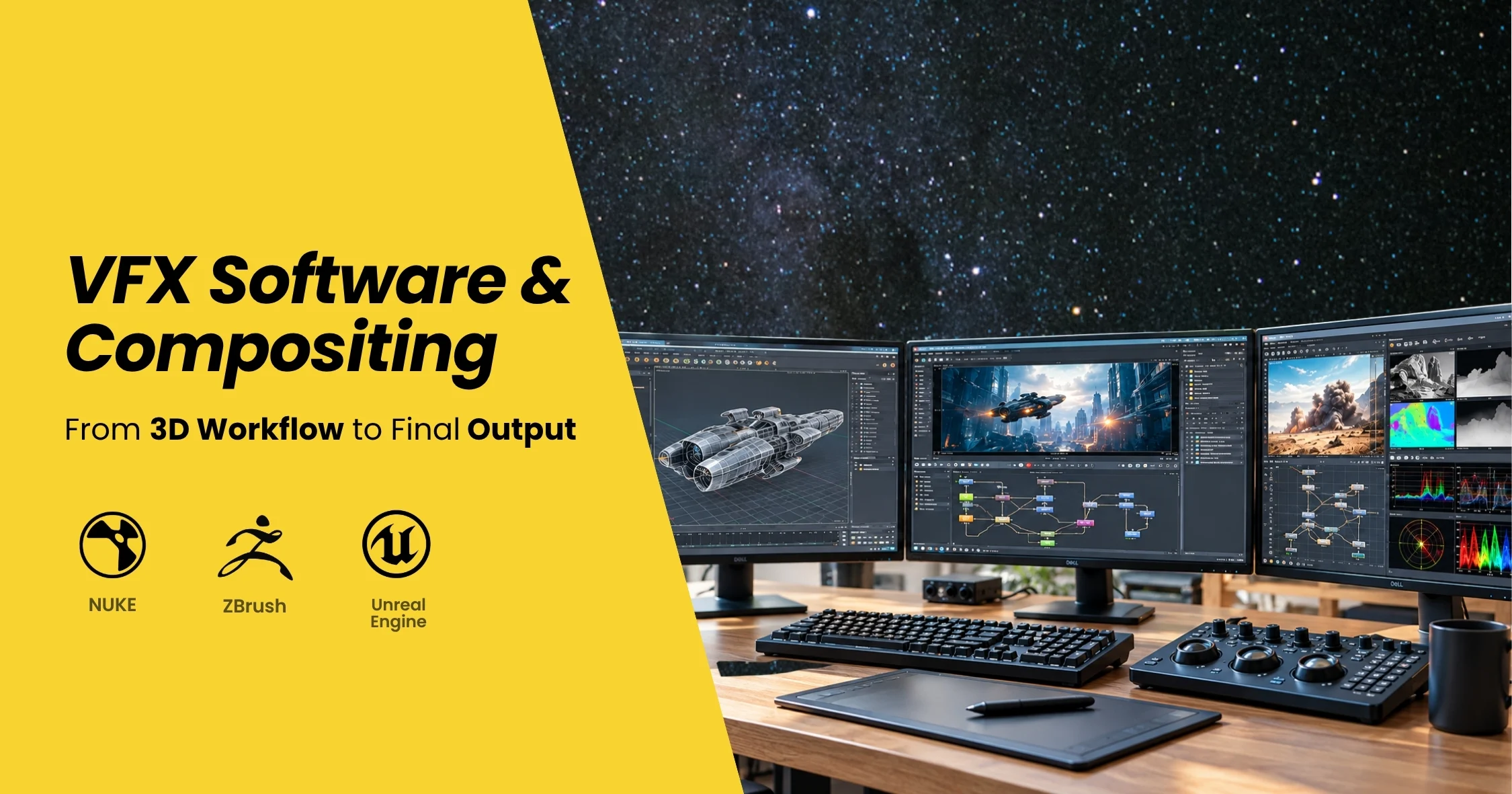
Knowing the software programs is only a fraction of knowledge needed to be successful in VFX. It's also important to have a sense of how the digital elements within a shot should look and behave.
A compositor has to understand how the colour, edges, shadows, grain, and the lighting of a digital element should correlate with the original source footage. A good 3D modeller should have an understanding of the form, dimension and the outer boundary of a subject, as well as the overall inquisitiveness.
Significant abilities involve.
Hues and textures
Notice small things
Sight viewing
Finding Solutions
Patience with intricate tasks
Collaboration and Conversation
Your role decides the software here. A compositor works mainly in Nuke and After Effects. Go the 3D route, and it's Maya, Blender, ZBrush. Houdini is pretty much the default for FX.
Explore OREAL World’s Compositing programme
You need not be an expert in every single program. One should get adept in the programs pertaining to one’s specialization and learn others when the situation demands it.
How do you build a VFX portfolio?
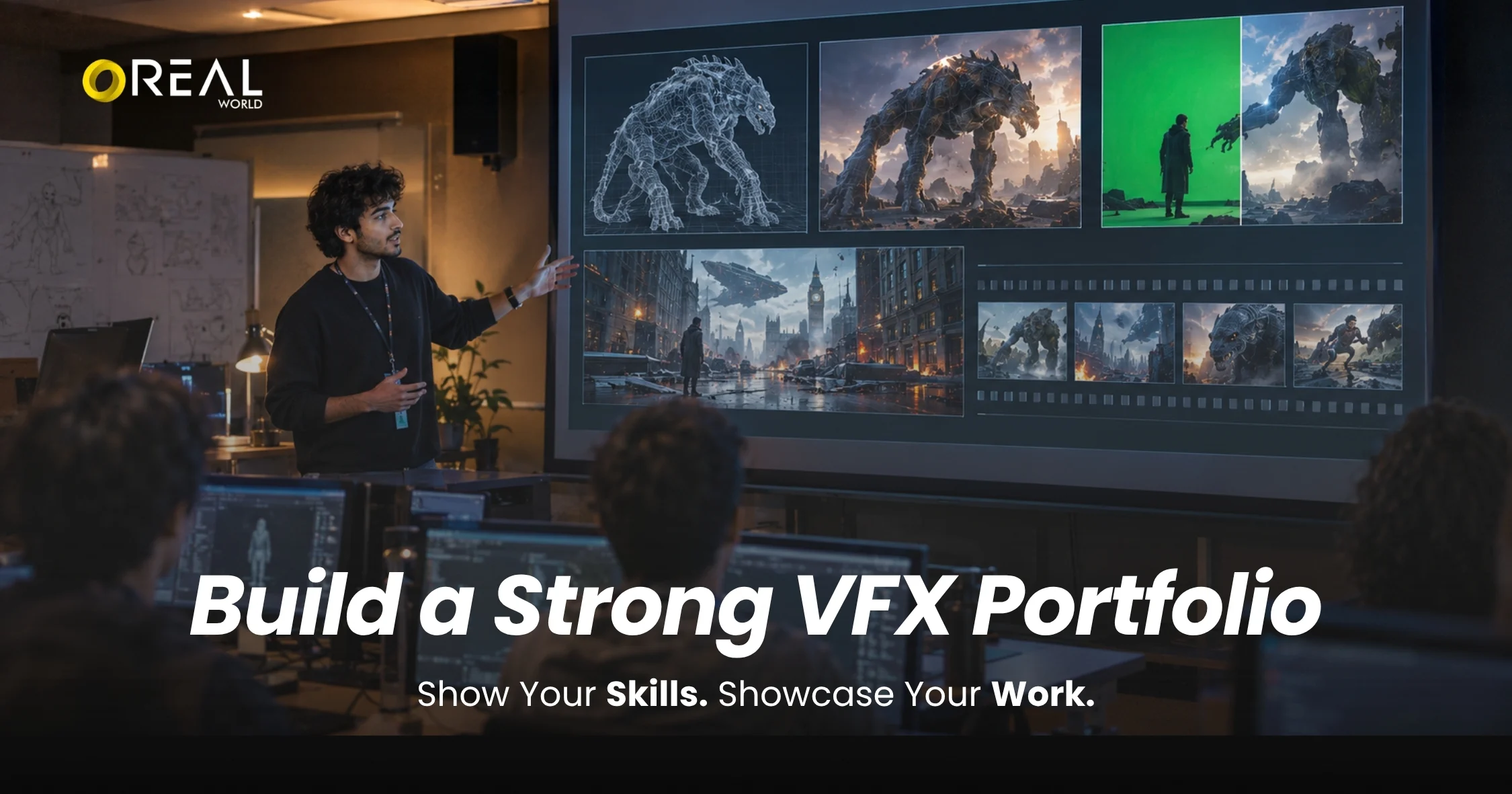
Your portfolio is your best evidence of what you know how to do. It is a certificate of accomplishment to show training; a portfolio demonstrates how you use what you trained.
A VFX portfolio can include:
A short showreel
Individual project shots
Before-and-after comparisons
Shot breakdowns
Wireframes and turntables for 3D work
Process stages where relevant
Personalize your portfolio to your position.
Footage of the individual elements and final composite should be shown by a compositor. A wireframe, textures, and a final render should be shown by a 3D modeller.
Some things can be created with little to no equipment. You can use your phone to make a simple video, add some quick and simple 3D elements and show that as a process piece, for example.
Keep your showreels short and always have your best work first. Show your least good work last.
How Can You Gain Practical VFX Experience?
VFX production is an effort. You may work on a single project to find your part is only one piece of a shot, sequence, or the entire production. The best way to learn about anything in production is to work on, or participate in, the actual production. There you will be taught about deadlines, workflow, revisions and feedback.
You can gain experience through:
Internships
Student short films
Freelance projects
Independent productions
Collaborative projects
Personal VFX projects
Easy to manage projects are a good place to start and make sure you finish them. Multiple unfinished projects are less impressive than a well-organized, clear, and completed 3-shot project.
In addition to the academic component, VFX training immerses students in actual industry projects and workshops, and prepares them for various jobs in the field.
OREAL World offers a project-based learning VFX Course.
In what areas of VFX can you work?
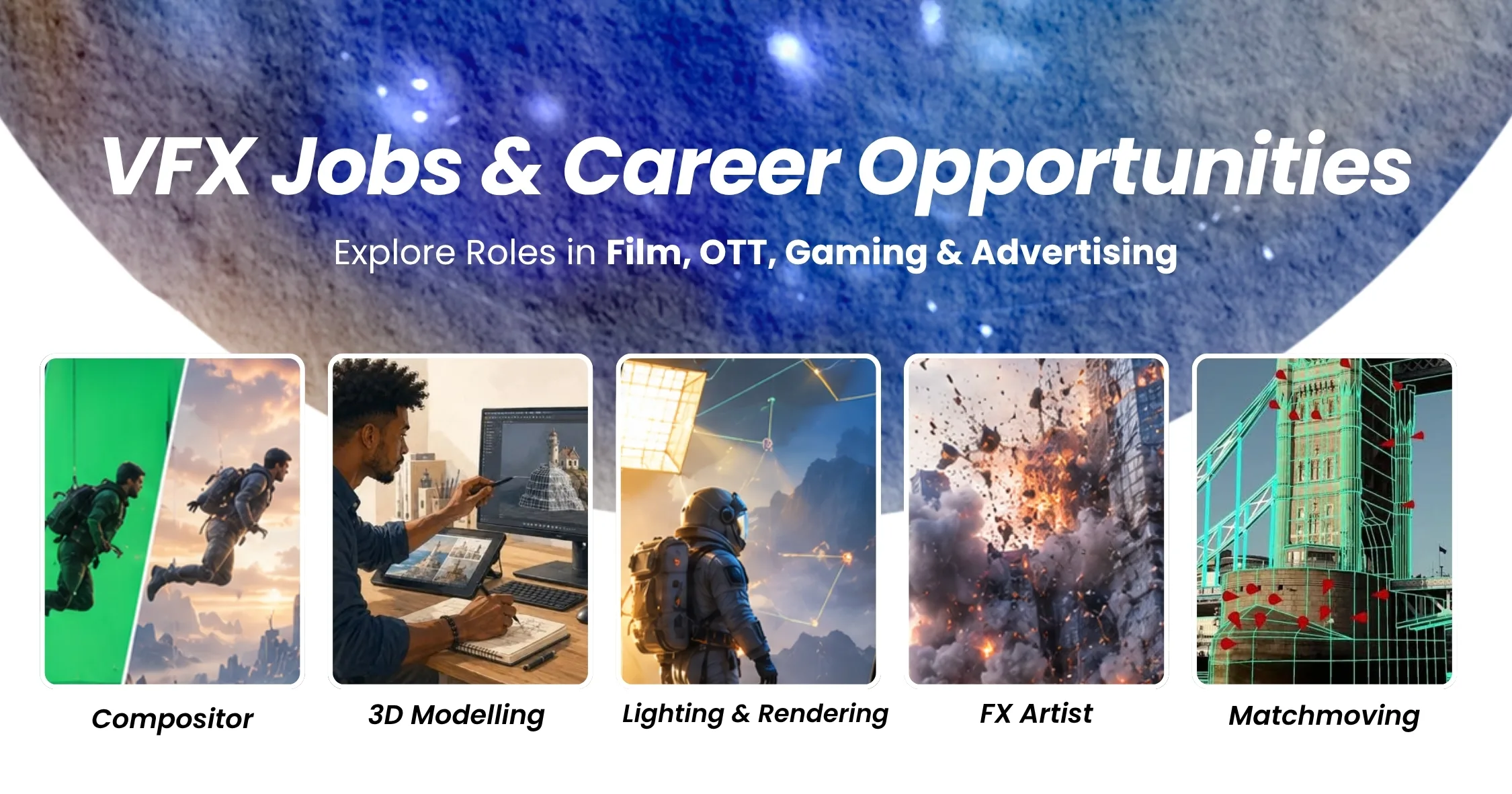
Many options are available in the field of VFX, and you can work in films, TV, OTTs, advertisements, games, and many other digital/online media. From these, you can build a strong career and employment opportunities based on your area of specialization and your portfolio.
Compositor
3D Artist/Modeller
Lighting Artist
Roto & Paint Artist
FX Artist
Matchmove Artist
Job titles and duties vary from studio to studio. Look carefully through each job post and not through job titles.
What Does a VFX Career Look Like?
The typical VFX career is an entry-level position to begin the career, with mid- to senior-level positions, and in some cases specialization, leads, and supervision.
Of course, not everyone’s career follows the same path. The specialization of the work done and the quality of that work, in addition to how well you collaborate, all determine the path your career takes.
Other fields such as advertising, OTT content, product visualization, game development, and immersive media have similar types of VFX work as in films.
What Factors Should I Consider When Selecting a VFX Institute?
The name and duration of VFX courses rarely reflect the quality of training. Review student work and see how much hands-on production training the course provides.
Practical training, along with the availability and access to software and other equipment, as well as mentorship and portfolio development, play a huge role in the training and learning experience.
Before enrolling, check:
Recent student showreels and project work
Practical training hours
Software used during the course
Trainer experience
Project reviews and feedback
Portfolio and showreel support
Internship or industry exposure
What are the red flags?
No recent student work on display
Film clips shown as student projects
Placement claims with no details
A long software list with no project examples
No showreel or portfolio guidance
Trainers who can't name a production they worked on
What should you ask before enrolling?
Can I see work from the latest batch?
How many hours are practical?
Who reviews student projects and showreels?
Which software will I use?
Are internships available?
Comparing two or three institutes with the same set of questions helps you understand what you're actually paying for.
How Can You Start Your VFX Career After 12th?
After 12th, don't decide in a hurry. At first, learn to understand different specializations. After that, improve your skills through training and practical projects.
A more practical approach will be:
1. Explore VFX specialisations
2. Choose a suitable VFX course
3. Learn relevant software
4. Work on projects
5. Build your creative portfolio
6. Get practical experience
7. Apply for VFX jobs
8. Continue learning.
Want to know the differences between VFX and 3D animation? The best way is to see what respective industries are teaching for creative and technical aspects.
Frequently Asked Questions
Is it possible to build a career in VFX after 12th, from any stream?
Yes, in most cases. Restricting VFX courses after 12th to only one stream is fairly uncommon. Look for admission page to see other admission requirements, such as a portfolio or aptitude test.
Is drawing skills necessary for a career in VFX?
It really depends on what role you want to pursue. Drawing skills can help if you are interested in 3D modelling or in Visual Development. However, for compositing, skills in colour sense and lighting would help more. Some institutes also test your drawing skills during admission, and this would also be mentioned on their admission page.
How long is a course at VFX?
How long a course lasts at VFX depends on the level of the course. A certificate course will last for about a year, a diploma course for two years and a degree course for three to four years.
What software should I learn first?
What you should learn first is determined by the role you want to take. For 3D modelling, Blender is a good choice. For compositing, you should learn After Effects or Nuke.
Is a degree necessary for VFX work?
Not necessarily, but the company you want to work for will definitely have preferences regarding degrees. Look over job descriptions and apply to the ones you think you're most qualified for.
How long before I get my first VFX job?
Again, this is really impossible to say. Look over the available jobs, your level of training, specialization, the portfolio you put together, and the job market in general. Based on all of these, you may be able to make an estimate.
Start Building Your VFX Career
If you’re interested in pursuing VFX after 12th, now’s the time to gain formal training in VFX. With this training, the field of work you can explore includes film, ad film, OTT, VFX gaming, animation, and digital media.
The first step is figuring out what kind of VFX work excites you, and then getting trained and/or mentored for that.
We know you’re excited! Explore OREAL World’s VFX programs, built on project-based learning to hone your creative and technical skills. See the programs, check the student work, and apply for the program that resonates with your goals the most.