How to Become a Graphic Designer: Skills, Tools & Career Path
Learn how to become a graphic designer in India. Explore essential skills, software, courses, portfolio tips, career options and salary.
If you liked to create posters during school days, you might have thought about how to become a graphic designer. The question sounds quite simple. But it’s actually difficult to answer. The reason is the different kinds of degree, diploma, and certificate courses.
Selection of the appropriate path would depend on what sort of graphic design work you like doing, what software you wish to use, and what sort of portfolio one wants to build. Getting a degree is just one possible way of starting. In most cases, employers take note of your graphic design work before checking any qualifications.
Look at the skills, software, courses, portfolio, and career paths covered ahead for graphic designers in India.
What Is Graphic Design?
Graphic design is the activity where we combine text, images, colours and layouts to convey a message to people who are interested in a particular brand. Most of the time, graphic design is not just about making images look good. It's about visual communication.
Logo for business/app
Ads/posters
Website banners
Product packaging
Social media posts
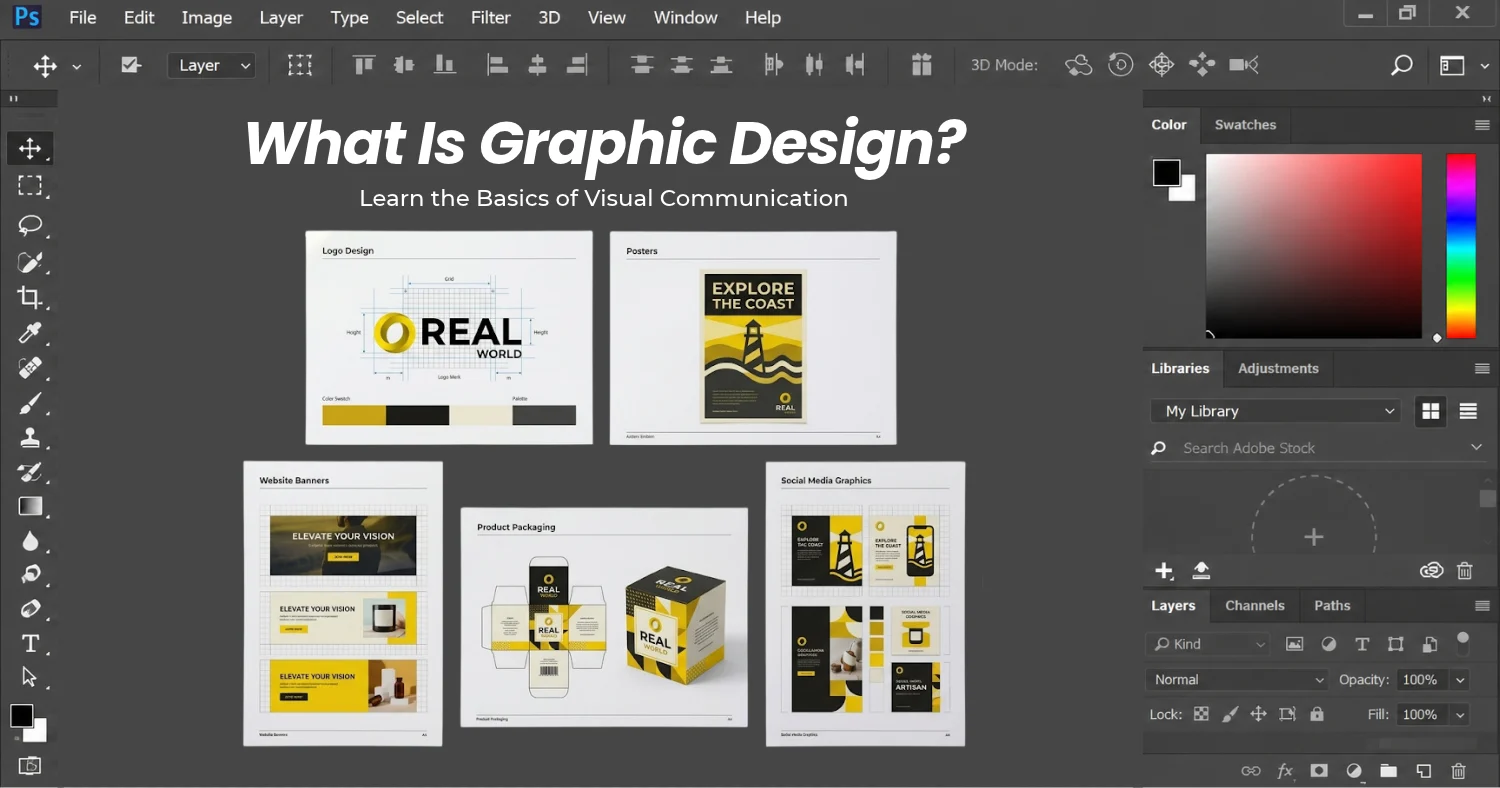
The quality of the creation of these graphic designs determines the ease with which we can understand a brand. Generally, the quality of good graphic design means a brand stands out.
Let's say a new bakery opens. They need to make their presence known to the people. Here, a graphic designer needs to understand what the bakery sells and for whom. The bakery will need a logo, product packaging, promotional posters, and social media posts. Through all this, the graphic design helps the business promote its products.
What Does a Graphic Designer Do?
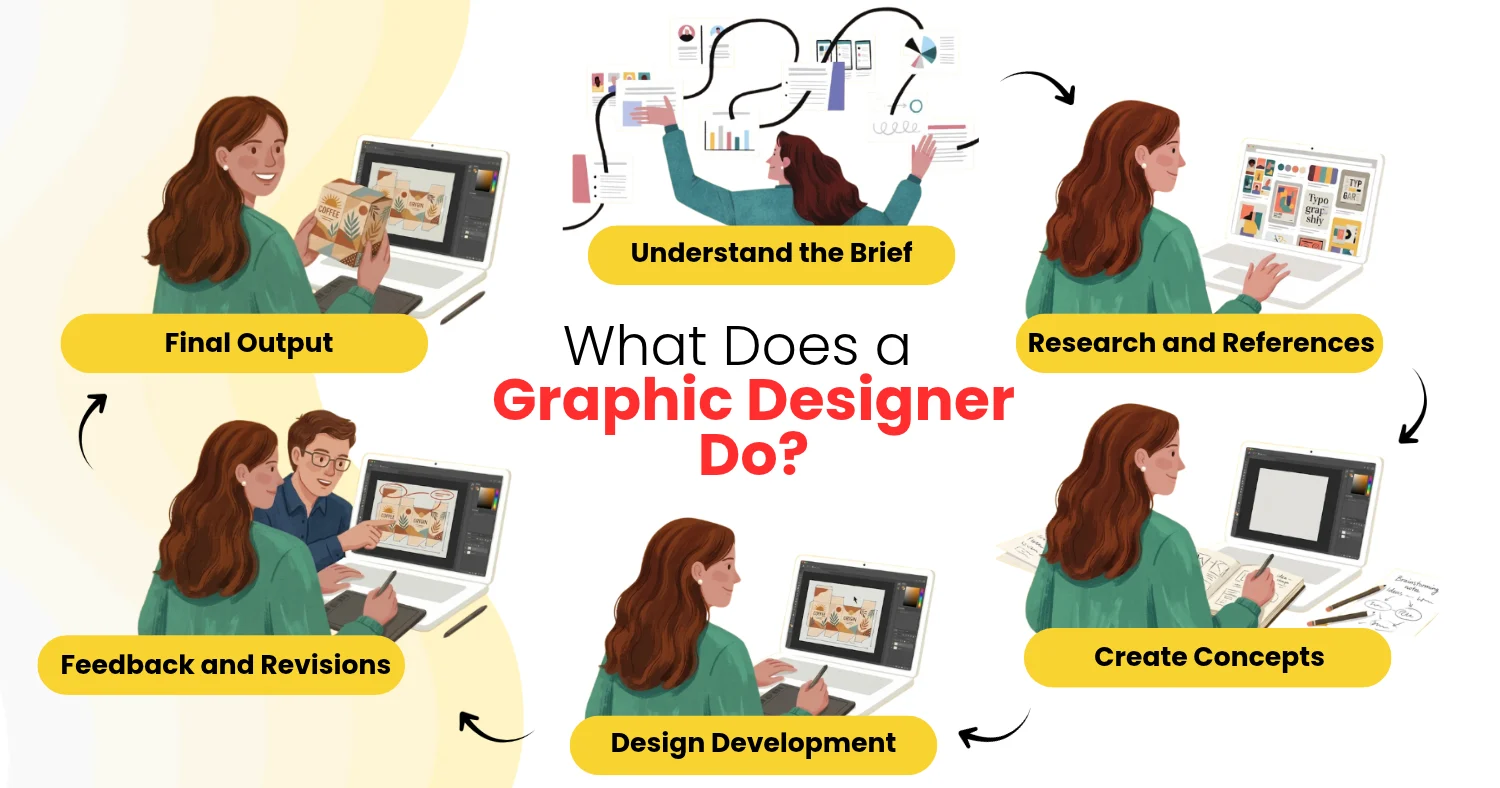
The graphic designer creates the designs based on the client’s requirements, as mentioned in the brief provided.
Their workflow includes the following steps:
Asking questions to understand the brief
Find out references, competitors, and styles
Creating rough drafts for different ideas
Building the selected idea in software
Taking feedback
Making the required changes
Exporting final files for print or digital use
Daily tasks of a graphic designer include
Logo design
Social media graphics
Brochures
Banners
Packaging
Image editing, etc.
A graphic designer develops visual content, but their work also involves discussions with different teams working on a project.
Skills You Need to Become a Graphic Designer
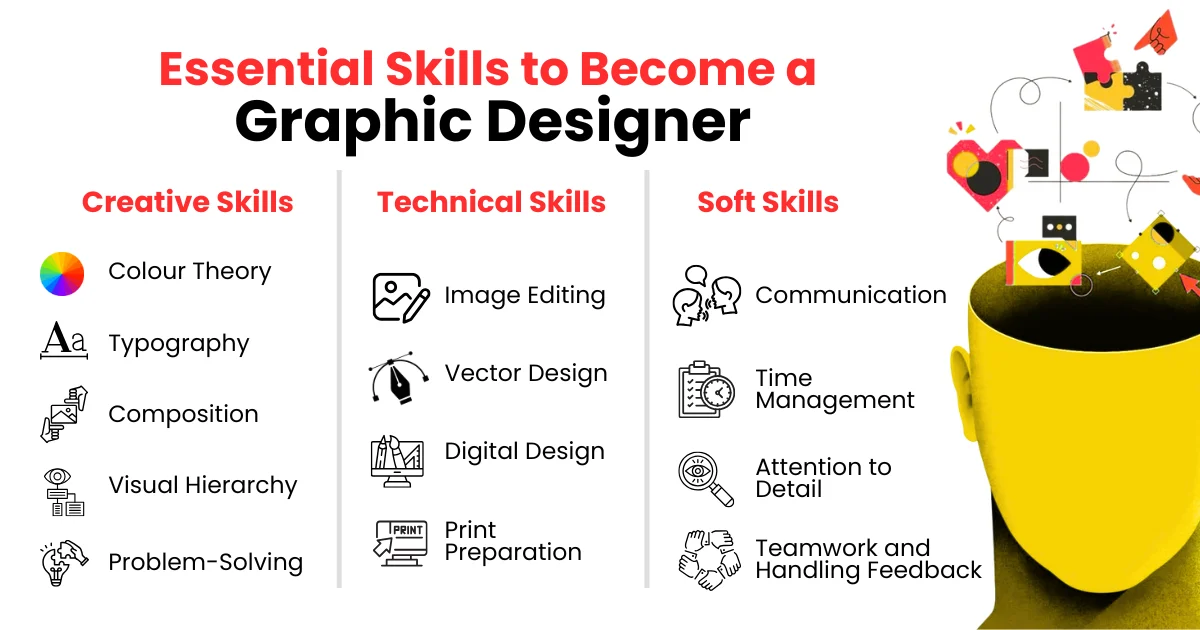
The graphic design skills can be divided into three parts as follows.
Creative Skills
Colour theory helps to know how colours are used together to create mood.
Typography assists in making choices and arranging the text in headings and body.
Layout and compositing give the design a final look
Visual hierarchy shows the most important information at first
Problem-solving skills help to create strategic designs.
For example, a children’s brand may use bright colours and round fonts, whereas a luxury brand may use a limited palette and thin, simple lettering.
Technical Skills
Image editing and photo retouching
Vector drawing to design a logo and icons
Designs for the website and Instagram
Print preparation, which includes sizes, file formats and colour settings
Soft Skills
Communication and listening
Time management
Attention to detail
Teamwork
Handling feedback
Don’t force yourself to learn all of these together.
Tools and Software Graphic Designers Use
Numerous tools are used. Look at the most commonly used software and tools.
Adobe Photoshop and Adobe Illustrator
Most of the graphic designers use Photoshop to create or edit images. By using this, you can easily remove the background of an image or poster.
Illustrator creates vector graphics, which can be resized without losing their quality. It is a common choice for logos, icons and illustrations.
Other Popular Design Tools
Tool | Main use | Common projects |
Photoshop | Image editing | Photo editing, posters, digital art |
Illustrator | Vector design | Logos, icons, illustrations |
InDesign | Page layout | Magazines, brochures, books |
Figma | Interface design | Website and app screens |
Canva | Quick graphics | Social media posts, presentations |
At first, learn Canva or any professional tool. Understand the basic features properly. When you are done with it, start with the next.
What Education and Qualifications Do You Need?
Most commonly, students prefer a degree and then start their career in graphic design. A few of the students focus on the software and tools to get started.
Make a decision on what you actually want.
Graphic Design Degree and Diploma Courses
Consider a degree or diploma after 12th, depending on your budget and available time. If you want to get into structured learning over years, go for a degree, whereas diploma courses are a bit short and focus more on particular skills and software.
In some institutes, you have to take an entrance test. So, read the eligibility and requirements very carefully.
Online and Certificate Courses
Online and certificate courses are good for learning design basics and some software. Online courses are a good fit for those looking for a flexible schedule.
Remember, a certificate alone does not show what you can do, so real projects are needed along with it.
Does a degree matter to start a Career in Graphic Design?
Some institutes have entrance tests. So, make sure to check their eligibility criteria before applying.
If you want to get structured learning over years, go for a degree, whereas diploma courses are a bit short and focus more on particular skills and software.
Steps to be a Graphic Designer
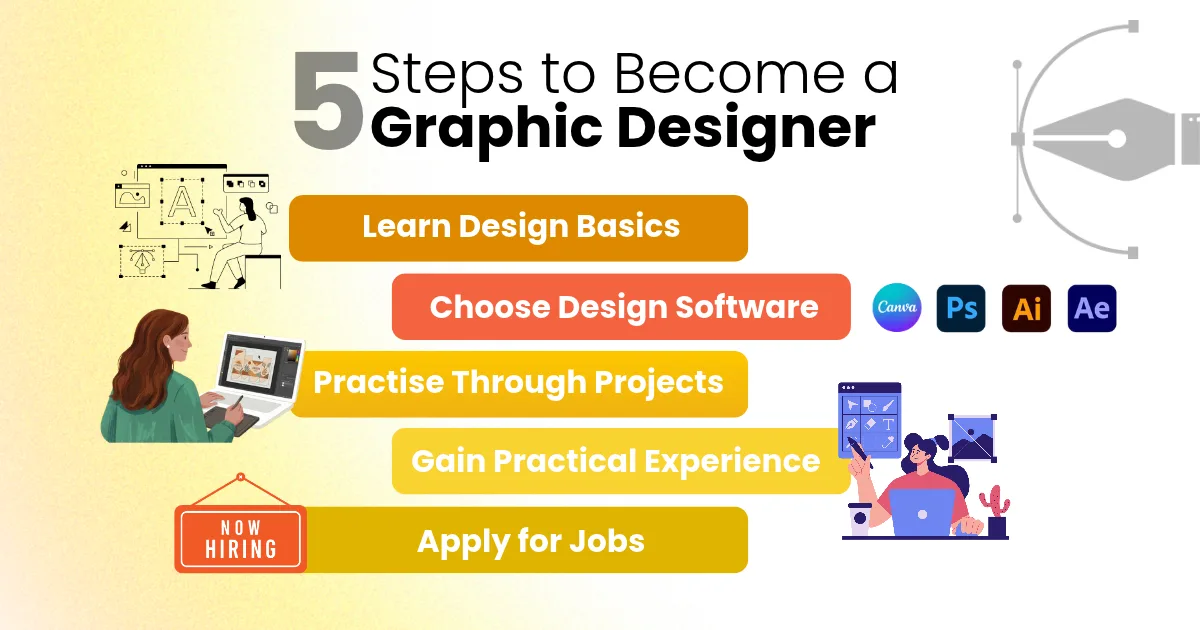
Let's have a look at a step-by-step plan to learn graphic design.
Step 1: Graphic Design Basics
Start by learning the design fundamentals. Learn balance, contrast, alignment, colour theory and typography. You can closely analyse the posters or brochures to understand the usage of text and colours.
Three tutorials, beginner courses and design books are enough at this stage.
Step 2: Choose and Learn Design Software
Understand what you are actually interested in before choosing design software.
Work you want to do | Software to start with |
Social media posts and quick graphics | Canva |
Photo editing and posters | Adobe Photoshop |
Logos and icons | Adobe Illustrator or CorelDRAW |
App and website screens | Figma |
Choose one of these and learn it for at least a month. Do not rush to start next. Get proficient in it first, then start the next one.
Step 3: Practise Through Design Projects
Theory becomes skill only after it is used, so small projects are important. Some ideas are:
Logo design for an imaginary bakery or clothing brand
Instagram post promoting a new product
Poster for a college event or music concert
Colours, fonts and style for a small business
Label or wrapper design for a made-up snack
These projects also give material for the portfolio.
Step 4: Gain Practical Experience
The following step is getting practical experience. You can work on the above ideas. This would help to learn to meet deadlines and make improvements based on the feedback.
Internships: get an internship for a short time in a marketing company. By working there, you might create banners or resize them as per the need.
Freelance projects: connect with local or small businesses. Design a logo or a menu for a newly opened restaurant.
Real client brief with a desired result, size, colour choice and deadline. Say, a gym wants a poster for its new batch of fitness. Need the poster ready in 3 days.
Get your work reviewed by your mentors/a professional designer. They'll help you out with the right type of feedback and help you understand your strengths/weaknesses.
Step 5: Apply for Graphic Design Jobs
After completing a few good projects, you can start applying to different companies like design firms, marketing companies, startups, and teams that work in-house. You might also want to think about doing some small freelance work on the side.
Have your resume and portfolio link prepared to share. When you get to the interview, you'll be glad to have these things readily available, so you can discuss your choices in your work. Be prepared to discuss the decisions you made about your design.
How to Build a Graphic Design Portfolio?
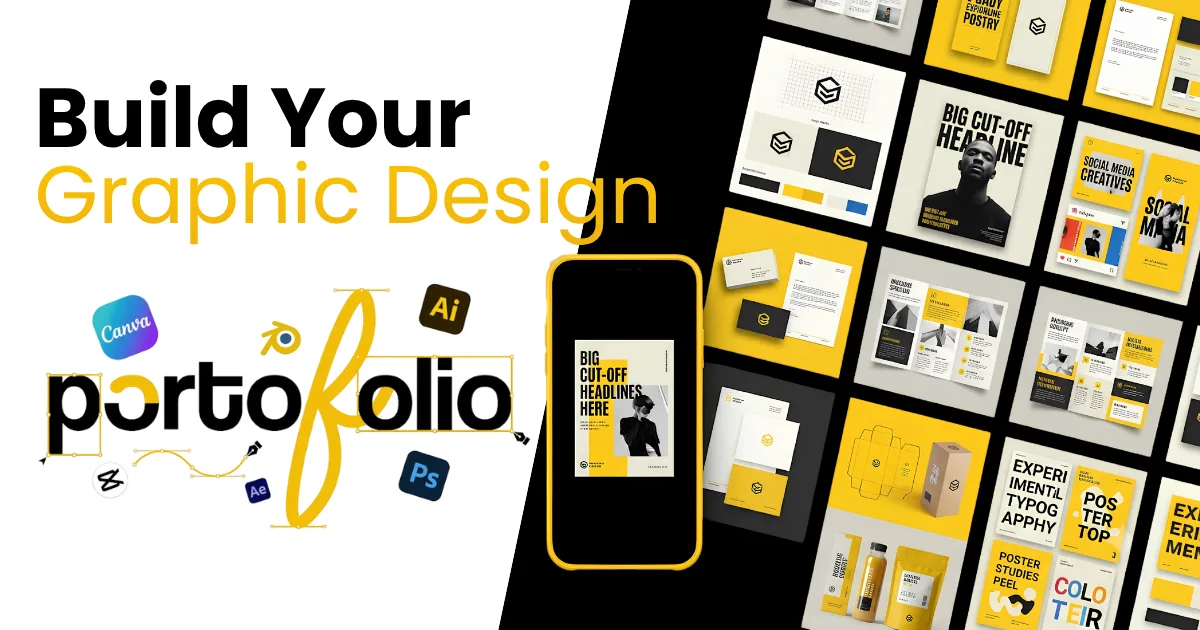
Employers nowadays hire someone who has a portfolio rather than those who know a list of software. They want to know what you can actually create using your design abilities.
What to Include in Your Portfolio
Logo and brand identity designs
Posters and promotional graphics
Social media posts
Brochures and layouts
Packaging concepts
Practice projects, even without a real client
Prefer to keep a brief note about your project. It should also be about your role, the main idea and the final output.
Where to Showcase Your Work
You can use Behance and Dribbble to share your projects. At the same time, you can look at the projects created by others.
Another option is to create a personal website to keep your work in one place.
Tips for a Strong Portfolio
Keep your strongest projects
Present different designs
Add sketches that explain the thought
Keep updating your portfolio
How AI Is Changing the Graphic Design Industry
AI has become an integral part of almost every industry. It is used in graphic design too. AI tools are used to generate ideas, rough drafts and finish lengthy tasks quickly.
How Designers Use AI Tools
Generating first ideas and rough concepts
Removing or changing image backgrounds
Editing and improving images
Testing different layouts and directions
Think of a graphic designer working on a festive campaign. The designer can get an idea about visual directions using AI and later create the design himself.
Benefits and Limitations of AI
The table below lists the main benefits and limitations of AI in design work.
Benefits | Limitations |
Speeds up repetitive tasks | Can give wrong or odd results |
Helps with idea generation | Does not fully understand the project |
Supports image editing | Raises copyright and originality concerns |
Allows quick experiments | Needs human review |
Skills Designers Need in the AI Era
No doubt AI can perform several tasks, but graphic design is still in demand. AI could just give you different ideas or options, but a designer has several skills that AI lacks. Problem-solving, communication skills and the ability to evaluate AI’s work are some of those.
What Are the Career Options in Graphic Design?
Graphic design as a career is full of opportunities. It’s used in several things like branding, advertising, product packaging, and digital content. Many of the students find it more interesting as it is a flexible career that keeps evolving with time.
Different Graphic Design Job Roles
The table below shows the common job roles and what each one does.
Job role | Main work |
Graphic Designer | Visuals for print and digital media |
Visual Designer | Look and style of campaigns and digital products |
Brand Designer | Logos and brand identity |
UI Designer | Screens for websites and apps |
Motion Graphics Designer | Animated graphics for videos and ads |
Packaging Designer | Boxes, labels and wrappers |
Once you start learning, you’ll notice that different roles overlap. Read Graphic Design vs UI/UX Design: Which is right for you? To get a better idea about this.
Where Can You Work?
Design and advertising agencies
Marketing companies
IT and technology businesses
Publishing and media organisations
In-house creative teams
Freelance projects
How Can You Grow in This Career?
You will get a range of specialisations after you've gained experience. These include branding, UI/UX design and motion graphics, for example. Your experience would lead you to senior positions like senior designer, art director or creative lead.
Career growth highly depends on your work, communication, design ability and experience.
Graphic Designer Salary and Job Opportunities in India
The graphic designer salary in India depends on experience, city, company, skills and specialisation.
How Much Does a Graphic Designer Earn at Each Level?
Per AmbitionBox, using approximately 67,500 salary reports and last updated on 8 March 2025, a graphic designer in India earns approximately 1.1 lakh to 7.2 lakh annually. Income from freelancing varies based on the number of clients, project budgets, and the consistency of work.
Level | Experience | Approximate yearly salary |
Entry level | 0 to 2 years | ₹1.1 lakh to ₹3 lakh |
Mid level | 3 to 5 years | ₹3 lakh to ₹5 lakh |
Senior level | 6 years and above | ₹5 lakh to ₹8 lakh |
These ranges are rounded from AmbitionBox data, so they should be treated as rough guides. The latest figures can be checked on the AmbitionBox graphic designer salary page.
The location is another factor which influences the graphic designer's salary. Gurugram and Pune, as you would expect, have the higher figures, and software product companies generally pay a premium over many other industries. Salaries are not guaranteed in this career, so remember to date every number and your role, location, and experience.
What Job Opportunities Are Available for Graphic Designers?
Various industries feature similar roles for jobs in graphic design, as nearly all brands need to develop their presence online and require visual representation of this.
Some common roles are:
Graphic designer
Visual designer
Brand designer
Social media designer
Packaging designer
Motion graphics designer
UI designer
Art director (senior position)
To get an idea about a current opening, check Naukri, LinkedIn, and Indeed; then compare the salary information there with Ambition Box and Glassdoor salary reports.
Learn Graphic Design at OREAL World
OREAL World is one of the design institutes in Noida. A wide range of visual design courses is available here. The graphic design program helps you develop design skills and allows you to have some hands-on experience. You will also work on some real projects that can be added to your portfolio to enhance it. Your project work is checked by professional guide members for any corrections.
If you are looking for some other courses than graphic design, explore the design and media courses and choose what you actually like.
Frequently Asked Questions
Can I become a graphic designer without a degree?
A degree is not needed for every graphic design job. Many of the employers just want to hire skilled individuals who have created some real projects. If you want, you can definitely get a degree before starting a career.
How long does it take to become a graphic designer?
It varies. Learning the basics can take a few months. But building experience and confidence might take even longer.
What should I include in my graphic design portfolio?
Logos, posters, social media posts, branding and packaging design work can be submitted. Please include a brief statement of the concept and development of each project.
Which software should a beginner learn first?
Canva is a simple starting point. After that, Photoshop can be learned for image editing, and Illustrator for logos and vector graphics, and Figma or InDesign can be explored as interests develop.
Is graphic design a good career for students?
It can be a good choice for students who like creativity and visual communication. Learning can begin during studies, and experience can come from practice projects and internships.
Will AI replace graphic designers?
AI can support design work, but creativity, communication and design judgement are still needed. Learning to use AI tools helps designers to adapt to changes in the industry.
Can I learn graphic design on my own?
Yes, it is possible through online tutorials, courses and regular practice. It is better to start with the basics, make small projects and ask for feedback.
Is Graphic Design a Good Career Option for You?
Graphic design suits students who enjoy visual work, can practise regularly and are comfortable with feedback and deadlines. It also needs patience, because skills such as typography and layout improve slowly through repeated projects.
Instead of waiting to feel ready, it is better to pick one small project, such as a logo or a poster, and finish it this week. Learning how to become a graphic designer starts with that first finished project.
For anyone planning a creative career in design, the graphic design course at OREAL World offers guided training and mentor feedback. Explore the course page to know more.