Animation vs VFX: Which Career Path Should You Choose?
Confused about animation vs VFX? Compare careers, skills, software, salaries, courses and job opportunities to choose the right path.
Are you still confused about animation vs VFX as a career? Let’s make a differentiation between the two by the work done. The main focus of animation is on creating characters, movements, and performance. On the other hand, VFX or visual effects are used to create and merge the visual elements in a shot to make it look believable.
Both offer different career opportunities in film, OTT, advertising, gaming, and digital media. Also, it opens the door for the wider AVGC-XR industry. The choice depends upon you. The kind of technical and creative work you enjoy matters more than you'd think.
Keep that in mind as you go through this guide; it covers animation and VFX careers, skills, software, salary factors, job roles, courses after Class 12, and future opportunities.
Animation vs VFX: What's the Difference?
The difference between animation and VFX is very clear.
Animation shapes movement and performance. VFX shapes a shot's realism by creating or blending visual elements into it.
Animation is like bringing a character, object, or environment to life. A VFX project includes filmed footage, CGI simulations, or multiple visual elements. All of these are combined together to create a final shot.
Some areas overlap in both, like 3D, lighting, rendering, visual storytelling, and digital production. But remember, the challenges and specialisations of both fields are very different.
What Does an Animator Actually Do?
Animation includes different works, such as 2D images and artwork, 3D characters, objects, and backgrounds for the whole sequence.
Animation creates motion that looks convincing. Although it involves rigging, keyframing, lighting, and rendering, it’s not a technical skill on a whole. It also needs quick observation and judgement.
For example, an animator may need to understand:
How a character shifts its weight before running
How facial expressions change during dialogue
How timing affects the emotion of a scene
How body language communicates personality
How movement should feel in a particular style
This is why animation is not simply about learning software. It is about understanding movement, timing, acting, observation, and storytelling.
What Does a VFX Artist Actually Do?
VFX isn’t as simple as most of us think. It’s much broader than editing the filmed footage.
Along with live footage, VFX artists also work on CGI, digital environments, simulations, tracking, rotoscoping, compositing, and other visual elements.
For example, a VFX artist might help:
Remove unwanted objects from footage
Integrate CGI into live-action scenes
Create digital environments
Track camera or object movement
Create smoke, fire, destruction, or fluid effects
Combine multiple elements into one believable shot
Match lighting and colour between different elements
The target is simple: make the shot so convincing that nobody watching stops to think about the process behind it.
Animation vs VFX: Quick Comparison
Factor | Animation | VFX |
Main purpose | Create movement and performance | Create or integrate visual effects |
Typical work | Characters, objects, animated scenes | CGI integration, environments, effects, compositing |
Core skills | Timing, movement, acting, observation | Realism, tracking, compositing, problem-solving |
Common tools | Maya, Blender, After Effects, and specialised 2D tools | Nuke, Houdini, Maya, Blender, and compositing tools |
Portfolio examples | Character animation, acting tests, 3D scenes | Compositing shots, CGI integration, VFX breakdowns |
Common career areas | Animation, gaming, motion graphics, digital media | Film, OTT, advertising, gaming, virtual production |
No field here is purely creative or purely technical. Since both demand creative judgement alongside technical ability. The real difference is in how that judgement and ability get used.
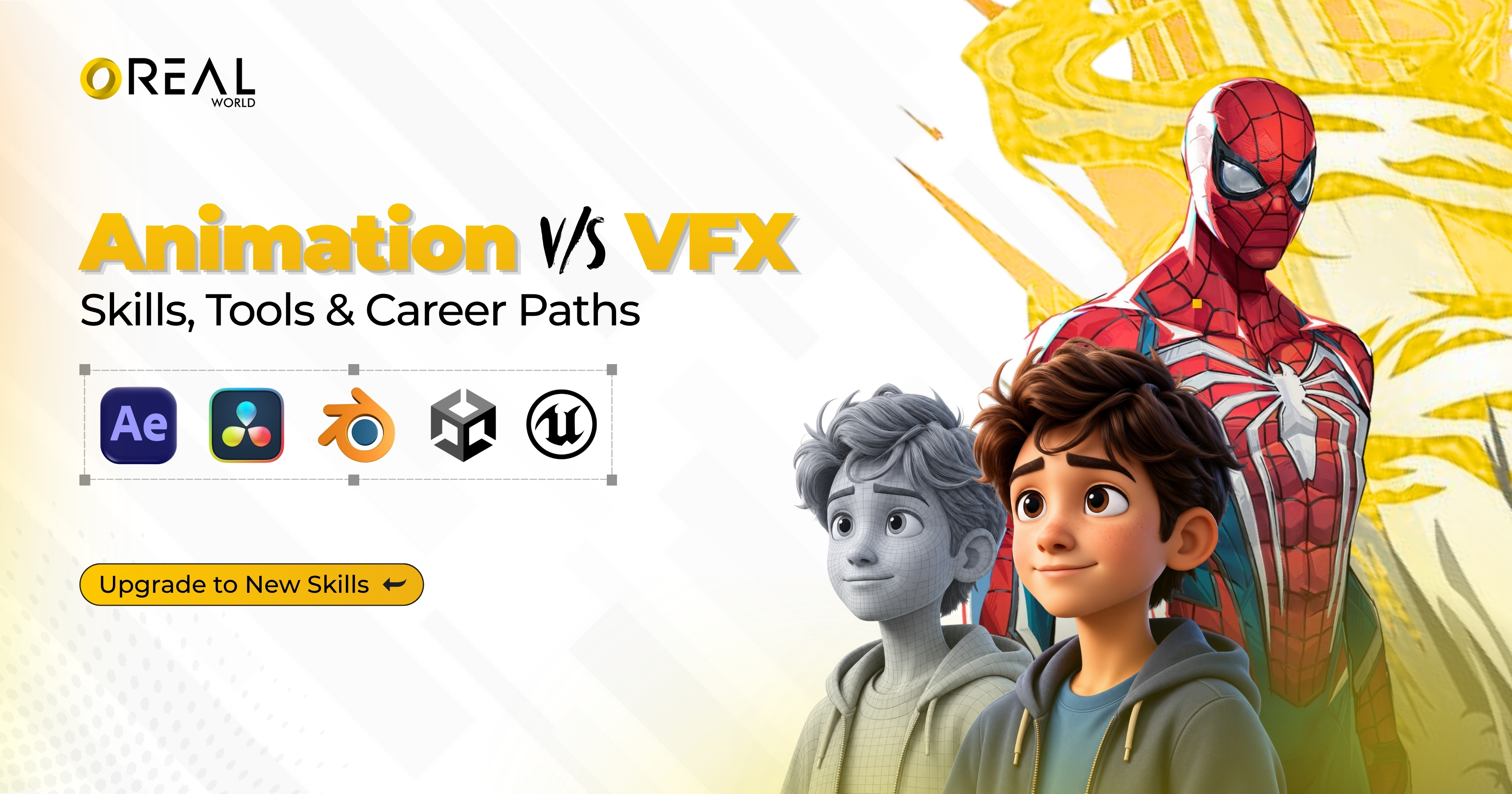
Where Do Animation and VFX Fit Into India's Creative Industry?
The AVGC-XR ecosystem ties together animation, visual effects, gaming, comics, and extended reality, with animation and VFX both playing a role in it.
The FICCI-EY Media & Entertainment Report 2026 shows 9% growth last year, bringing the sector to ₹2.78 trillion, with more growth expected in 2026.
Animation and VFX have their own trajectory. A separate government estimate from February 2026 valued that industry at about ₹103 billion in 2024, with a projected rise to ₹147 billion by 2027.
Since these figures come from two different reports covering different segments and timeframes of the AVGC-XR industry, they shouldn't be treated as the same data.
What actually matters for the students is that the industry growth won’t get you a job.
Employers and clients aren't impressed easily. They want specialised skills, real experience, and a portfolio that backs up your ability.
Animation and VFX Careers: What Jobs Can You Build?
In animation and VFX, there is no single career path. Each field offers multiple specialisations.
Common Animation Career Options
Depending on your interests and training, animation can lead to roles such as:
2D Animator
3D Animator
Character Animator
Motion Graphics Artist
Game Animator
3D Artist
Lighting Artist
Layout Artist
Pre-visualisation Artist
Common VFX Career Options
VFX can lead to specialised roles such as:
Roto Artist
Matchmove Artist
Compositor
FX Artist
Lighting Artist
Environment Artist
CG Artist
Tracking Artist
VFX Generalist
What Does the Work Actually Look Like?
Role | What the artist produces | Key skill |
2D Animator | Movement within 2D artwork | Timing and motion |
3D/Character Animator | Digital character performances | Acting and observation |
Motion Graphics Artist | Animated graphics and branded content | Visual communication |
Game Animator | Character and object movement | Animation + game logic |
Roto Artist | Isolated elements from footage | Precision |
Matchmove Artist | Camera/object tracking data | Technical accuracy |
Compositor | Final combination of visual elements | Visual judgement |
FX Artist | Smoke, fire, destruction, and simulations | Technical problem-solving |
Lighting Artist | Lighting for digital scenes | Light and colour |
A useful career strategy is to understand the wider pipeline and then develop deeper expertise in one area.
Animation vs VFX Salary: Which Career Pays More?
If you also have this question: “Does animation pay more than VFX?”
Remember, there is no reliable answer to this question.
can vary considerably depending on:
Job role
Experience
Technical skill
Specialisation
Portfolio quality
Studio or company
Location
Project type
Freelance or full-time work
International client exposure
Here's the thing about pay in this industry: it focuses on skill, not category.
An inexperienced animator can lose out to a compositor with years behind them. A junior VFX artist may earn less than a character animator who’s actually mastered the skill set.
So, choosing a career based on the pay offered by the field can be misleading.
What Usually Helps Increase Earning Potential?
Doesn’t matter which field you choose, professionals become more valuable when they demonstrate:
Strong technical fundamentals
A specialised skill
Production-ready portfolio work
Good problem-solving ability
Consistent quality
Understanding of professional workflows
Ability to work with feedback and deadlines
Your showreel or portfolio can therefore be more useful than mentioning the software names on your CV.
Which Is Better: Animation or VFX?
There is no universal winner.
Animation may be better for you if:
You enjoy creating characters and movement.
You are interested in acting and storytelling.
You notice body language and facial expressions.
You enjoy building scenes or characters from scratch.
You like refining movement until it feels right.
Character animation or animated worlds interest you.
VFX may be better for you if:
You enjoy solving visual problems.
CGI and realistic effects interest you.
You like working with footage.
You enjoy compositing, tracking, or simulations.
You are interested in making digital elements look realistic.
You enjoy understanding how complex movie shots are created.
Quick Decision Guide
If you enjoy... | Consider... |
Character movement and acting | Animation |
2D drawing and movement | 2D Animation |
3D character performance | 3D Animation |
Graphic design + movement | Motion Graphics |
CGI integration | VFX |
Tracking and compositing | VFX |
Smoke, fire, and destruction | FX/VFX |
Interactive characters | Game Animation |
If you find both interesting, no problem. Try to explore both animation and VFX before making a final choice.
Animation or VFX After Class 12: Which Should You Choose?
Students often search for animation courses after Class 12 or VFX courses after Class 12 without first deciding what type of work they actually want to learn.
A better approach is to start with your interest and then compare courses.
Your interest | Possible direction |
2D characters and storytelling | 2D Animation |
3D characters and performance | 3D Animation |
Film effects and compositing | VFX |
Design and animated graphics | Motion Graphics |
Characters and interactive worlds | Game Animation |
Real-time digital experiences | Game/XR |
You do not need to know your entire career path immediately after Class 12. But being aware of your preferred work can help you select the right course.
How to Choose an Animation or VFX Course After Class 12
Course selection is important because a long list of software does not necessarily mean strong training.
Before enrolling, check the following.
1. Curriculum
Look for fundamentals as well as specialised production skills.
A good curriculum should not simply list software. It should explain what you will actually create and how your skills will develop.
2. Practical Projects
Ask to see actual student projects.
For animation, look for:
Character animation
Walk cycles
Acting tests
3D scenes
Short animation projects
For VFX, look for:
Compositing
Tracking
Rotoscoping
CGI integration
VFX breakdowns
3. Faculty Experience
Check the professional and production credentials of the faculty.
It's experienced mentors who can push feedback past classroom theory and into practical territory.
4. Portfolio and Showreel
A certificate shouldn't be the finish line.
What you graduate with should be work that proves what you can actually produce.
5. Feedback and Mentorship
Regular critique is important. Ask whether students receive specific feedback on their projects and how often they can revise their work.
6. Placement Information
Do not rely only on broad placement claims.
Ask for specific information about:
Job roles
Hiring companies
Internship opportunities
Placement process
Portfolio requirements
Career support
What Should a Good Animation or VFX Programme Teach?
A strong programme should ideally combine four areas:
Creative Foundation
Visual storytelling
Composition
Observation
Design principles
Movement
Colour and light
Technical Foundation
Relevant software
2D/3D workflows
Rendering
Compositing
Digital production techniques
Production Thinking
It's not enough to do the task; students should understand how that task connects to the larger production pipeline.
Portfolio Development
A programme's real job is helping students produce presentable work, the kind studios, agencies, clients, or employers would take seriously.
That outweighs simply working through software tutorials.
What Software Is Used in Animation and VFX?
Software depends on the specialisation and production pipeline.
Animation professionals may work with tools such as:
Maya
Blender
After Effects
2D animation software
VFX professionals may work with:
Nuke
Houdini
Maya
Blender
Tracking and compositing tools
How many applications you know isn’t the point.
Being genuinely skilled with one or two tools relevant to your specialisation carries more weight than knowing a little about ten.
Can You Switch Between Animation and VFX Later?
Yes.
Animation and VFX share foundations such as:
3D
Lighting
Rendering
Visual storytelling
Digital production
Understanding of cameras and composition
Don't assume specialisations can be interchanged easily.
Knowing 3D animation helps with another 3D discipline, up to a point, but it won't hand you compositing or FX skills.
Get a solid foundation down first, then specialise from there.
How Is AI Changing Animation and VFX Careers?
Creative workflows look different because of AI now. What hasn't changed is the need for people who actually know the craft.
AI tools show up mostly in ideation, generating references, repetitive work, experimentation, and select parts of production.
At the same time, human skills remain important:
Creative judgement
Storytelling
Visual quality control
Character performance
Composition
Problem-solving
Art direction
Understanding production requirements
The safest approach for you is:
Do not ignore AI, and do not depend entirely on it.
Instead, learn the basics of your discipline and try to understand how AI can support the workflow.
A Five-Minute Animation vs VFX Career Test
To make a better decision, give yourself a point for each statement that is according to your interest.
Animation
I enjoy making characters move.
I am interested in acting and performance.
I like telling stories through movement.
I notice how people move and express emotions.
I would enjoy building a character or scene from scratch.
VFX
I enjoy making impossible things look believable.
I like solving visual problems.
CGI and visual effects interest me.
I enjoy working with footage.
Compositing, tracking, simulations, or digital effects sound interesting.
If one field already sounds more appealing, that's a decent place to start.
Still unsure? Try a small project in each.
Put together a short animation test, then a simple VFX exercise, maybe removing an object from footage or adding a digital element to a shot.
Then ask yourself:
Which project would you want to keep improving even after you had technically finished it?
That answer can tell you a lot about the type of work you naturally enjoy.
Why OREAL World Can Be a Starting Point for Your Creative Career
Deciding between animation and VFX is the first step. Step two is harder: figuring out which programme actually teaches those skills.
While comparing the institutes, look for the same factors discussed in the guide: practical projects, experienced faculty, portfolio development, relevant tools, feedback, and career support.
You can explore OREAL World Animation programmes and VFX programmes to understand the two learning paths.
For the students interested in animation, 2D Animation and 3D Animation are worth exploring. If compositing and visual effects are more your interest, the VFX Compositing programme fits better.
The important thing is to compare the skills, projects, curriculum, mentorship, and learning process, rather than choosing a course simply because its title sounds attractive.
FAQs About Animation vs VFX
Is Animation better than VFX as a career?
Neither is automatically better. Animation may suit students who enjoy character performance, movement, and storytelling, while VFX may suit those who enjoy visual problem-solving, CGI, compositing, tracking, and realistic effects.
Which is better after Class 12: Animation or VFX?
Start with your interests. Then compare the curriculum, practical projects, faculty, portfolio development, and career support of the courses you are considering.
Is VFX a good career in India?
VFX is part of India's wider AVGC-XR ecosystem and has applications across film, OTT, advertising, gaming, and digital production. However, career success depends heavily on specialised skills, portfolio quality, experience, and the ability to work within professional production pipelines.
Does animation require drawing skills?
Drawing can be useful, particularly for 2D animation and visual development, but different animation roles require different skill sets. 3D animation, for example, focuses heavily on movement, acting, timing, observation, and digital production.
Does VFX require drawing?
Not every VFX role requires strong drawing ability. Roles such as compositing, tracking, rotoscoping, and certain technical disciplines rely more heavily on visual judgement, precision, software skills, and problem-solving.
Which software is better for animation and VFX?
There is no single best software for every role. Maya and Blender are widely used across 3D workflows, while Nuke is commonly associated with professional compositing and Houdini with procedural and FX work. The right software depends on your specialisation and the production pipeline.
Can I learn Animation and VFX together?
Yes. The two fields share some foundations, including 3D, lighting, rendering, and visual storytelling. However, developing deeper expertise in one specialisation is generally more useful than remaining at a basic level across many disciplines.
Can I switch from Animation to VFX later?
Yes. Your existing understanding of 3D, cameras, lighting, rendering, and digital production can provide a useful foundation. You will still need to learn the specific skills required for your new VFX specialisation.
Which has more job opportunities: Animation or VFX?
Both fields contain multiple career paths, so comparing the industries only by the number of jobs can be misleading. Opportunities vary by role, specialisation, location, studio demand, and experience.
Final Verdict: Animation or VFX?
Animation and VFX are not competing career choices where one is always better than the other.
Animation is a strong direction for people who enjoy characters, movement, acting, storytelling, and building digital scenes.
VFX can be a strong direction for people who enjoy CGI, compositing, visual effects, tracking, simulations, and solving visual problems.
Both are part of a broader creative-tech ecosystem, and both reward professionals who develop specialised skills and build strong portfolios.
So, instead of asking only “Animation vs VFX: which is better?”, ask:
“Which type of work would I enjoy practising repeatedly until I become good at it?”
That is usually a much better starting point for choosing a creative career.
For additional information about India's media and entertainment ecosystem, refer to the FICCI-EY Media & Entertainment Report 2026 and relevant publications from the Ministry of Information and Broadcasting.
Explore OREAL World to learn more about animation, VFX, and other creative technology programmes.
Frequently Asked Questions
Is Animation better than VFX as a career?
Neither is automatically better. Animation may suit students who enjoy character performance, movement, and storytelling, while VFX may suit those who enjoy visual problem-solving, CGI, compositing, tracking, and realistic effects.
Which is better after Class 12: Animation or VFX?
Start with your interests. Then compare the curriculum, practical projects, faculty, portfolio development, and career support of the courses you are considering.
Is VFX a good career in India?
VFX is part of India's wider AVGC-XR ecosystem and has applications across film, OTT, advertising, gaming, and digital production. However, career success depends heavily on specialised skills, portfolio quality, experience, and the ability to work within professional production pipelines.
Does animation require drawing skills?
Drawing can be useful, particularly for 2D animation and visual development, but different animation roles require different skill sets. 3D animation, for example, focuses heavily on movement, acting, timing, observation, and digital production.
Does VFX require drawing?
Not every VFX role requires strong drawing ability. Roles such as compositing, tracking, rotoscoping, and certain technical disciplines rely more heavily on visual judgement, precision, software skills, and problem-solving.