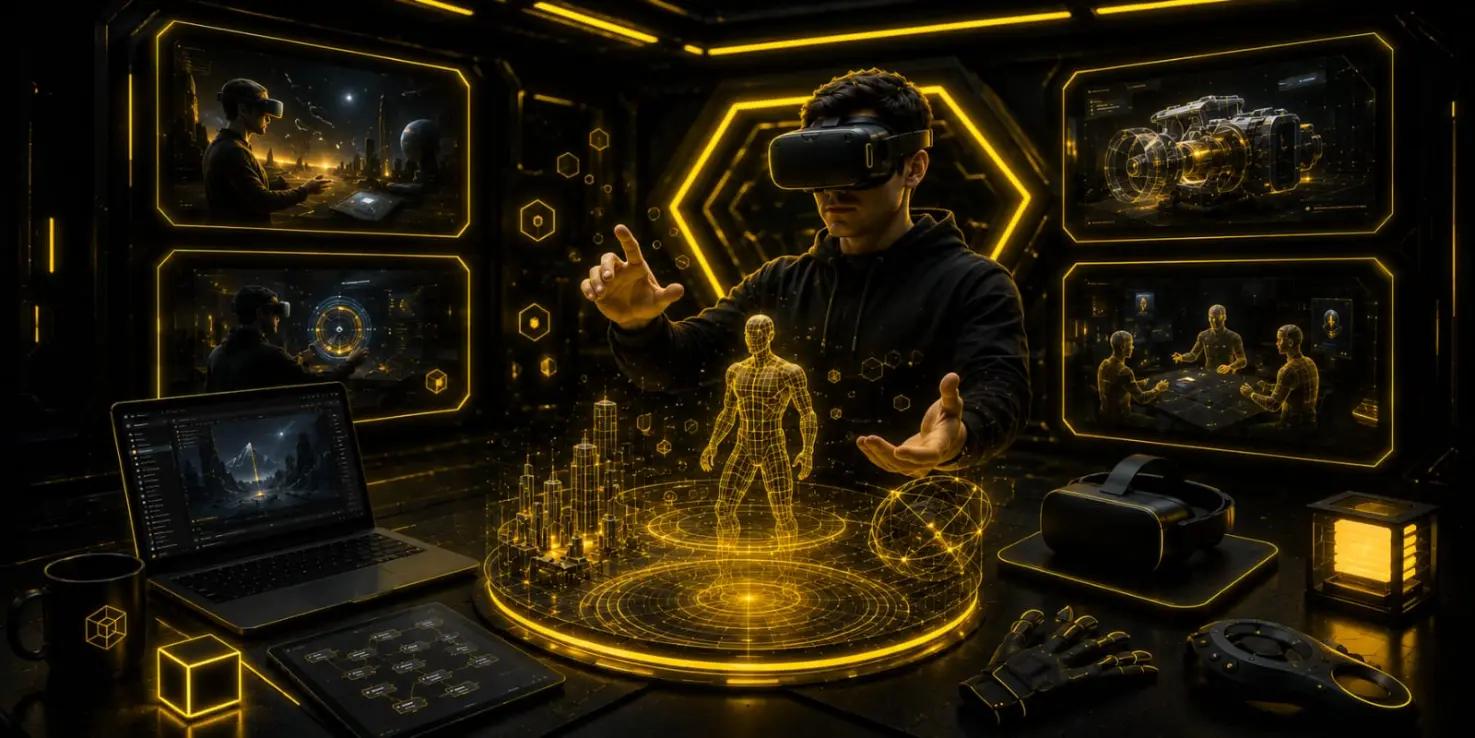
XR Technology Program
GAME DEVELOPMENT & XR

XR Technology Program

Course Overview

XR TECHNOLOGY CAREER PROGRAM IN NOIDA

Digital experiences are moving into spaces where people can see, explore,e and interact with content in new ways. Augmented Reality, Virtual Reality,ty and other forms of extended reality are changing how digital technology can be used. The XR Technology Program introduces students to these technologies while also asking a wider question: what can we actually do with them?

Students begin by understanding the technology behind AR, VR, MR, and XR. Rather than treating each term as a separate software topic, the programme helps them see how different immersive technologies can support different types of experiences.

The human side of XR becomes important as soon as users enter the experience. Students explore how people move through digital space, respond to interactive content, and engage with immersive environments. This creates a connection between technical development and the way an experience is actually used.

Students then experiment with immersive interactions and digital content. The aim is not simply to make something that demonstrates a technology, but to explore how XR can be used to create a meaningful experience.

Experimentation also means learning from what does not work. Students can test their concepts, observe interaction problems, and refine their ideas as they move from an early experiment towards a more usable XR experience. This makes the XR technology course in Noida different from a conventional game development pathway.

The programme also looks beyond entertainment. XR technology can be explored in areas such as education, training, simulation, retail,l and marketing, along with other applications supported by the curriculum. This gives students a wider view of how immersive technology can be applied to real-world experiences.

Students can develop an XR concept and use the resulting work to build a portfolio around immersive technology. The focus is on showing curiosity, technical understanding, and the ability to experiment with emerging forms of digital interaction.

The XR Technology Program can support opportunities in XR development, AR/VR development, immersive technology, XR design, and interactive experiences. Its progression is built around technology, human interaction, practical application, and experimentation, rather than following the traditional game-development route.

12-13 Months
Duration
150-160
Classes
Software & Tools
UnityUn
Unreal EngineUE
Git & Version ControlG&V
OpenXRO
Learning Journey

What You'll Learn in XR Development

Develop the technical, creative, and problem-solving skills required to build immersive AR, VR, and Mixed Reality applications for gaming, education, healthcare, architecture, manufacturing, and enterprise solutions.
Curriculum Module 01

XR Foundations

Understand how immersive technologies work and explore the principles behind Extended Reality experiences.
XR Development
Immersive Design
User Experience Design
Interaction Systems
Curriculum Module 02

Virtual Reality Development

Create interactive virtual environments that allow users to explore, learn, and interact naturally.
VR Development
VR Interactions
Hand Tracking
Teleportation Systems
VR Optimization
Curriculum Module 03

Augmented & Mixed Reality

Build applications that merge digital content with the physical world through real-time interaction.
AR Development
Marker-Based AR
Markerless AR
Object Placement
Mobile AR
Mixed Reality
Spatial Computing
Curriculum Module 04

Enterprise & Real-Time Applications

Discover how XR technologies are applied across industries to solve practical business and training challenges.
Interactive Applications
Training Systems
Simulations
Industry Readiness
Production Pipelines
Curriculum Module 05

Software & Tools Covered

Learn professional XR development tools used to build immersive experiences across multiple platforms and industries.
Unity
Unreal
OpenXR
Unity XR Toolkit
Curriculum Module 06

Projects & Portfolio

Create real-world immersive applications that demonstrate your ability to develop practical XR solutions.
XR Application
Interactive Training Simulation
Immersive Experience Project
Industry Showcase Project
Final Portfolio
Career Opportunities

Your FutureStarts Here

Build the skills required for careers in immersive technology, spatial computing, and interactive application development.
Career Path

XR Developer

Career Path

AR Developer

Career Path

VR Developer

Career Path

Interactive Experience Developer

Career Path

Real-Time Application Developer

5+ Career PathsAgency & Studio ReadyFreelance Opportunities
Portfolio Development

Students Graduate With

Graduate with a portfolio that showcases your ability to develop immersive experiences for real-world applications.
Scene 01

XR Development Portfolio

Scene 02

AR & VR Application Portfolio

Scene 03

Interactive Experience Project

Scene 04

Industry Showcase Project

Scene 05

Technical Development Portfolio

Got Questions?

Frequently AskedQuestions

Everything you need to know before starting the XR Technology Program program.

An XR Development course teaches you how to create immersive digital experiences using Extended Reality (XR), which includes Virtual Reality (VR), Augmented Reality (AR), and Mixed Reality (MR). You'll learn to build interactive applications for gaming, education, training, healthcare, and other industries.
Augmented Reality (AR) overlays digital content onto the real world. Virtual Reality (VR) creates a fully immersive virtual environment. Mixed Reality (MR) blends physical and digital objects, allowing them to interact in real time. These concepts are introduced as part of the XR development curriculum.
This course is suitable for beginners, students, game developers, designers, programmers, and professionals who want to explore immersive technologies and build XR applications.
You'll create practical XR projects such as interactive VR environments, AR experiences, and immersive applications that demonstrate your understanding of XR development workflows.
After completing the course, you can pursue entry-level roles such as XR Developer, AR Developer, VR Developer, Unity XR Developer, or Immersive Experience Developer across gaming, education, healthcare, architecture, manufacturing, and simulation industries.

Related Courses

Start Your Journey

Back to Courses