Complete Guide to Animation Courses in India (2026): Types, Eligibility, Fees, Duration, Career & Salary
Confused about which animation course to choose? This comprehensive guide covers course types, admission requirements, fees, duration, career prospects, and salary to help you make an informed decision.
Animation in India is no longer confined to cartoons and movie VFX. Studios now make explainer videos for ed-tech companies, motion graphics for brands, 3D walkthroughs for real estate firms, and VFX shots for Hollywood and OTT shows. Animation work has spread far beyond "cartoon studios," and most guides on animation courses in India have not caught up with this change.
This guide covers the basics you need: course types, eligibility, fees, and duration. But it also covers what most blogs skip, such as a real career roadmap, salary by specialisation, what employers actually look for, and how AI is changing animation jobs. If you are comparing animation courses after 12th, choosing between a 3D animation course and a VFX animation course, or just wondering if this field is worth it in 2026, this guide will help.
Start Your Animation Career Today
Not sure which animation course is right for you? Get expert guidance on choosing the best certificate, diploma, bachelor's, or PG program based on your career goals.
What Is an Animation Course?
The idea of an animation course is to teach you how to turn those static shots of your life into motion, whether done with drawings, 3D models, digital tools, or by working frame-by-frame or relying on some of the techniques available from good animation software such as rigging or keyframing.
In short, an animation course will help you understand questions like “how does my cartoon character walk?” or “how does a 3D object move on-screen?”
What You'll Learn During an Animation Course
Most of the animation courses in India, regardless of their duration, cover some basic concepts that are important to learn before picking your specialisation.
Drawing & Visual basics: Anatomy, perspective, composition, colour theory
Storyboarding & Visual storytelling: Planning out your shots, scenes, and pacing before diving into animating
2D & 3D Animation: Keyframing, timing, rigging, character movement
Modeling, Texturing & Lighting: creating believable 3D characters, props & environments
Compositing & Post-production: blending animated with live action elements, colour correction, shooting & finishing your shot!
Software Training: software taught based on your interest and need, such as Maya, Blender, toon boom after effects unreal engine etc.
Who Should Choose an Animation Course
Animation is for those who enjoy both the creative and technical side of the task. If you like drawing or telling stories visually, and you also don't mind spending long hours learning software and redoing a shot until the timing feels right, this field is a good fit for you.
You do not need to be a great artist to start. Many successful 3D animators, riggers, and VFX artists cannot draw very well. Their strength is technical skill, spatial thinking, and patience with software. Drawing matters more if you want to do 2D animation, character design, or storyboarding specifically. It matters less for the field as a whole.
You also do not need to be strong in maths or science. Basic arithmetic helps with timing and proportions, but this field rewards creativity, observation, and steady practice far more than exam scores.
The Indian Animation Industry in 2026- Scope, Demand & Career Opportunities
India's animation industry is experiencing rapid growth, driven by the increasing demand for digital content across OTT platforms, gaming, advertising, education, and enterprise applications. According to a Research and Markets report, the Indian animation market was valued at USD 2.4 billion in 2024 and is projected to reach USD 14.69 billion by 2030, growing at a compound annual growth rate (CAGR) of 35.04% during the forecast period. This growth is creating new career opportunities for skilled professionals across animation, VFX, game development, motion graphics, and 3D content creation.
What's Driving the Growth of Animation in India
Here are some things that are raising the demand for animation professionals in India.
OTT & Streaming content: Streaming content providers require an uninterrupted inflow of animated shows, ads, and title sequences. A lot of them are being done by animation studios in India.
Mobile & Console Gaming: India’s gaming industry has been growing at a rapid rate, leading game studios to vie with film studios to attract top talent in animations & 3D.
Global VFX Work: Indian studios handle post-production and visual effect services for international movies and television series, offering steady but project-based work.
Advertising & D2C Brands: motion graphics and short animated videos are now a standard part of social media marketing, not an extra
Ed-tech and corporate training: explainer videos and animated learning content have created a whole new type of hiring that barely existed ten years ago.
Where Most Animation Jobs Are Located
Animation and VFX jobs in India are mostly concentrated in a few cities, though remote and freelance work has changed this a bit:
Delhi-NCR (including Noida): home to several animation institutes and studios, mainly for advertising and broadcast animation
Mumbai and Pune: the biggest hub for VFX studios, film post-production houses, and animation companies
Hyderabad: a growing base for gaming studios and VFX houses, partly because costs are lower than in Mumbai
Bengaluru: strong for gaming, motion design, and tech-related animation work like app motion design and product visualisation
Freelancers and remote motion designers are not tied to these cities in the same way. A large share of freelance animation work in India today is done for clients in the US, UK, and Europe.
Which Industries Hire Animation Professionals
Other than the film & television industry, you’ll find that having animation skills will come into demand in:
Gaming studios (character art, environment art, gameplay animation)
Advertising / Marketing Agencies (Motion Graphics, Social Media Content
Ed-tech and e-learning companies (explainer and training videos)
Architecture & Real Estate Firms (3d Walkthroughs & Product Visualisation)
Healthcare & Pharma Companies (Medical Animation & Training Content) App & Product Design Teams (UI & UX Motion Design)
That’s why this is such an important consideration to make as you choose your courses.
For instance, if you are targeting game studios, you’ll need very specific software that will be vastly different from what you’d need to get into ad agencies or architecture firms.
Types of Animation Courses in India
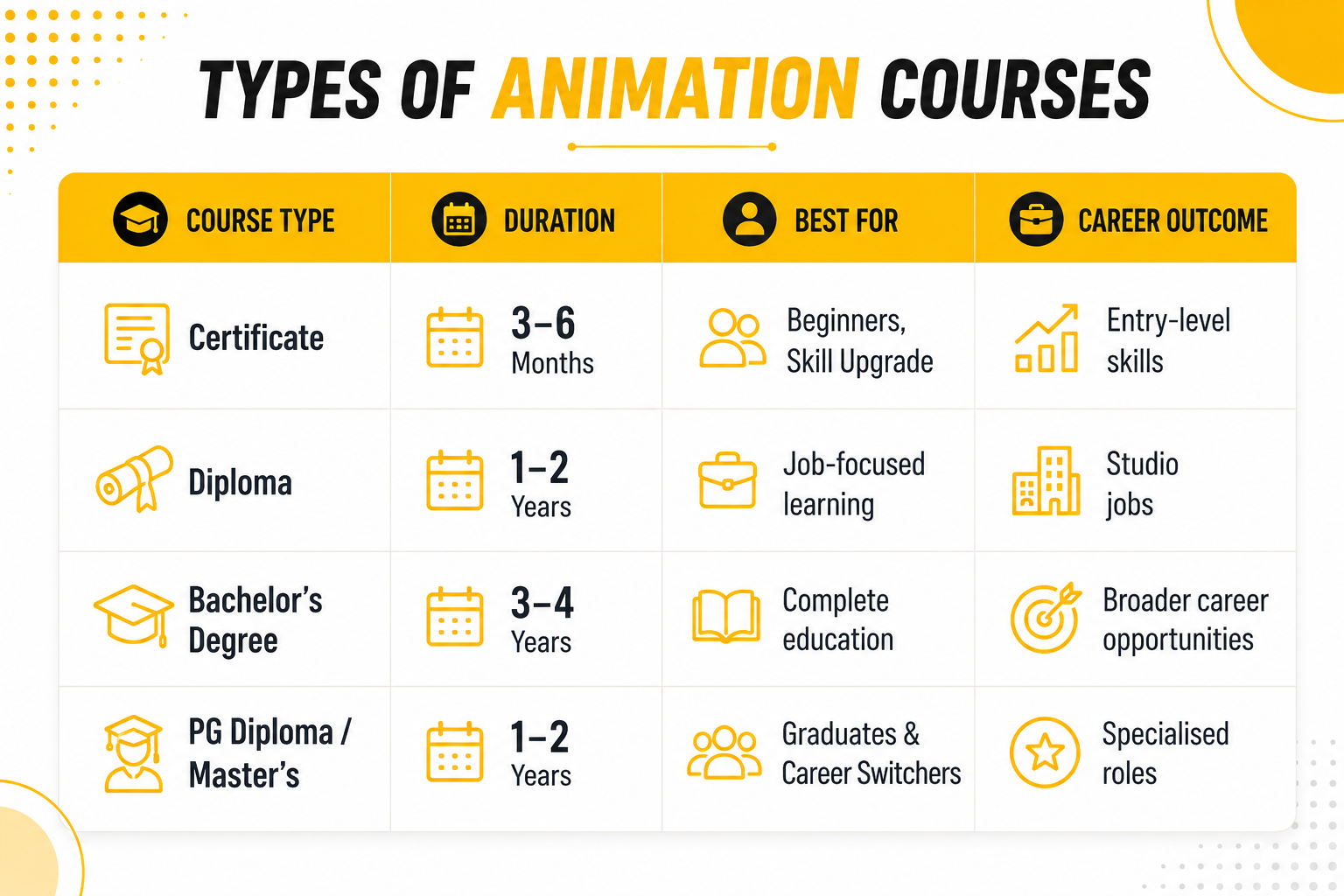
Different kinds of animation courses are available in India. You can opt for a short-term certification course, diploma, and degree programs. Understand the difference in duration, eligibility, curriculum, and outcome. This’ll help you choose the right course based on your goal and experience.
Certificate Courses
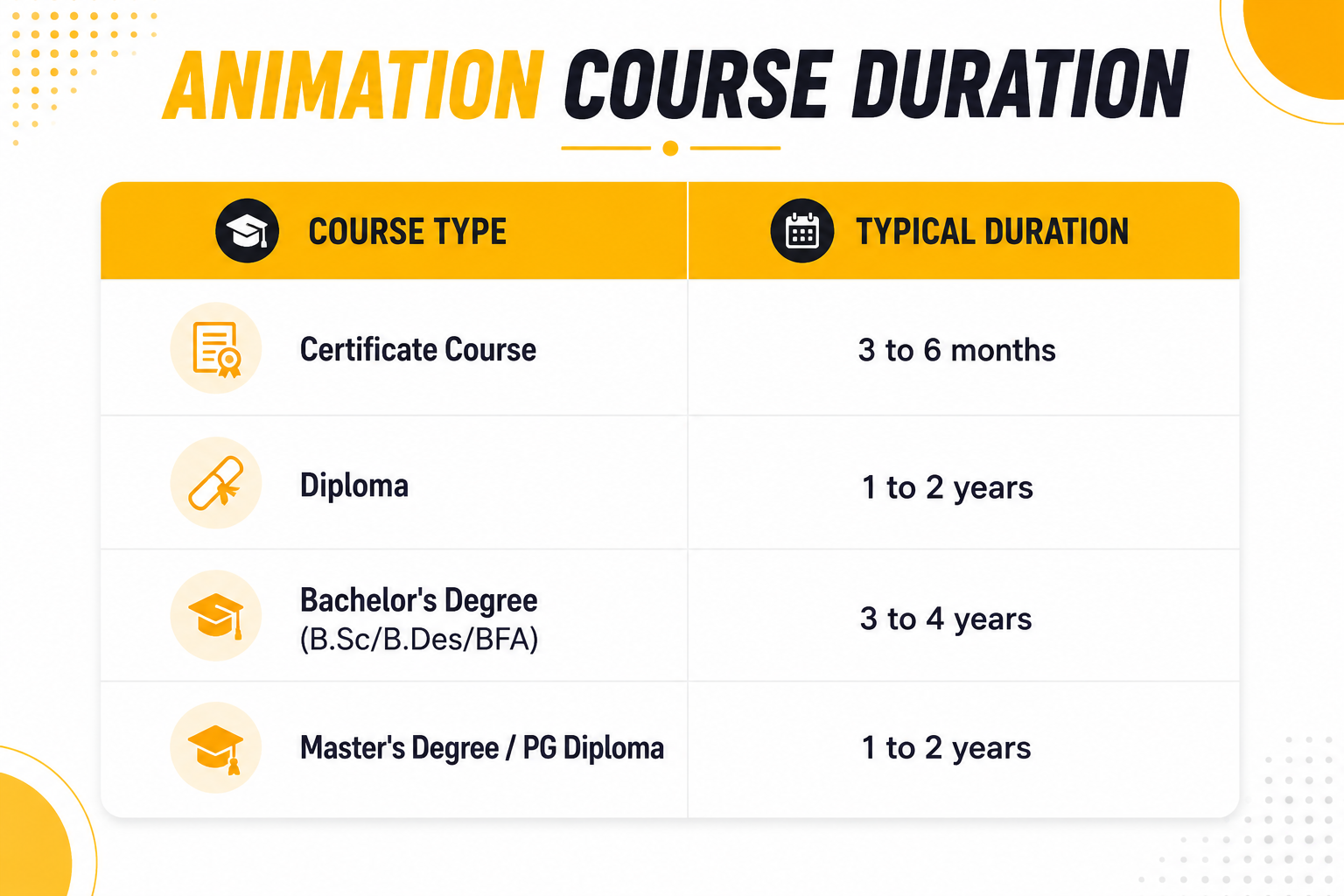
These certificate courses can last anywhere from 3-6 months and teach skills ranging from 2D animation basics to motion graphics, and even certain software like After Effects. It’s a great way to try out whether animation is right for you. Or pick up an additional new skill that complements your current portfolio. But by themselves, these certificates won’t hold much water when thinking of going into animation full time. But they do give you a good starting point or add-on to your existing resume!
Diploma Programs
Diploma programs usually run 1 to 2 years and go much deeper than certificate courses. They cover both the basics and a chosen specialisation, such as 2D animation, 3D animation, VFX, or game art. Many working animators in India hold a diploma instead of a degree, because studios care more about the portfolio a diploma produces than the certificate itself.
Animation Degree Courses
Bachelor's-level animation degrees, like BSc in Animation, B.Des in Animation and VFX, or BFA programs, usually run 3 to 4 years. These give you the most complete training: art basics, technical skills across many software tools, and often internships or live projects. They suit students who want a broad foundation before specialising, or who might later want to move into direction, art direction, or teaching, where a degree carries more weight.
Master's Degrees & PG Diplomas in Animation
Postgraduate programs, usually 1 to 2 years, are for students who already have a bachelor's degree (in animation or something related) and want to go deep into one area, such as VFX, game design, or technical art. These are less common as a first step into the industry. They work better for students aiming at senior or leadership roles, or the course type you choose.
Eligibility After 10th, 12th & Graduation
After 10th: There are a few short-term certificate and foundation courses which accept students straight after Class 10, especially as an early exposure to digital art and software.
After 12th: This is the most usual entry point. Diploma and degree programs (BSc, B.Des) normally require simply a pass in 10+2, from any stream: arts, commerce or science. Some design degree programs will require a portfolio or an aptitude exam, but you don’t need a fine arts background.
After Graduation: If you have a bachelor’s degree in any topic, you can apply for a PG diploma or a master’s course in animation. This is common for those transferring careers into animation, VFX, or game design.
Need Help Choosing the Best Course?
Whether you're a 10th pass student, 12th pass student, graduate, or working professional, our experts can recommend the ideal animation course for you.
Animation Course Duration
3D Animation, VFX & 2D Animation Course Fees
The course fee depends upon the institute, your city, and the course. It also varies if you’re pursuing it through a government or private institute or college. As a rough guide for 2026:
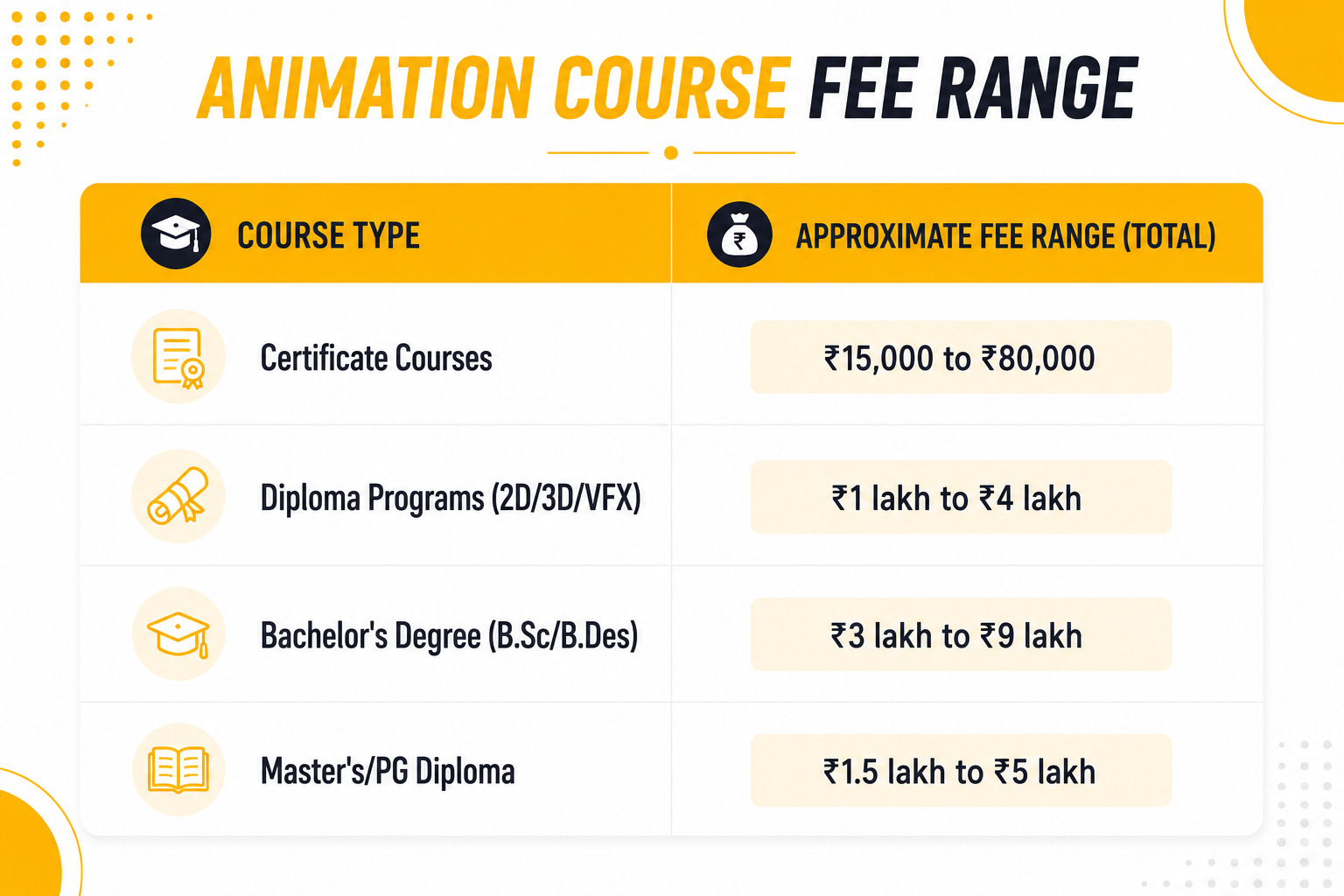
Government institutions and university programs tend to be cheaper. Private animation institutes with a bigger brand and placement support often charge more. Don’t think a higher fee means better training; look at the tools, lab access, and industry guidance the course truly delivers.
Hidden Costs Students Often Overlook
Before you enrol at any institute or college, make sure to ask them if the course fee includes every cost or not. Check
Software licenses: many institutes include this in the course; however, some do not. Tools like Maya, Nuke, or Toon Boom Harmony can be costly outside of student licences.
Hardware: a decent laptop or desktop with a good GPU is a must for 3D animation and VFX work. Most students end up upgrading their system partway through the course.
Portfolio costs: printing, hosting a personal website, or paying for stock assets for your final-year projects.
Drawing tablets: a graphics tablet (like a Wacom) is almost necessary for 2D animation and character design students.
Animation vs VFX vs Game Design - Which Career Path is Right for You?
These three fields share some software and basics, but the actual day-to-day work is quite different. Picking one without understanding the difference is one of the most common regrets students report a year or two into their course.
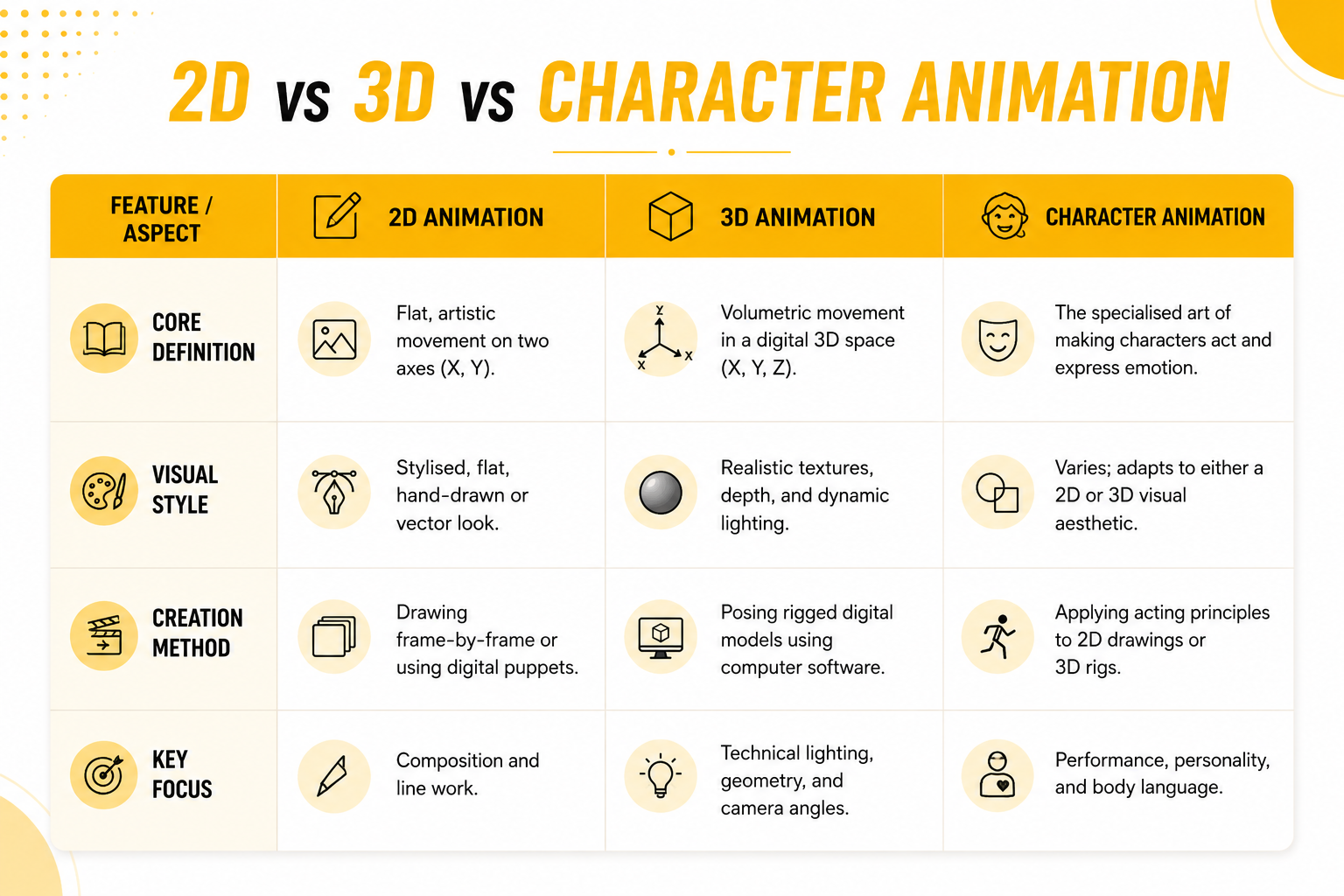
2D Animation vs 3D Animation vs Character Animation (key difference)
While 2D and 3D define the medium and technology used, character animation is the artistic discipline of bringing those figures to life. Use this quick breakdown to see how they stack up.
FX vs Motion Graphics vs Game Animation (Skills & Software Required)
VFX (Visual Effects) is about compositing, simulations (fire, smoke, water), and the combining of animated or CG elements with actual video. Main tools: Nuke, Houdini, After Effects. VFX artists are most often used in post-production teams for film, TV, and advertising.
Motion Graphics is animation used for graphic design, such as title sequences, social media content, UI animation, and branded videos. The main tool is Adobe After Effects, often used with Cinema 4D for 3D motion work. It's one of the easier specialisations to break into, and it has strong freelance demand.
Game Animation focuses on the creation of game characters, environments, and effects for a better gameplay experience. Software like Unreal Engine and Unity are used along with Maya and Blender for game asset creation. It needs an understanding not just of animation, but of how movement responds to what a player does. This is different from film or broadcast animation.
Salary, Demand & Career Growth
Talent is crucial, but so is earning potential. Here’s a simple side-by-side look at average income, industry demand, and leading career routes in VFX, motion graphics, and game animation.
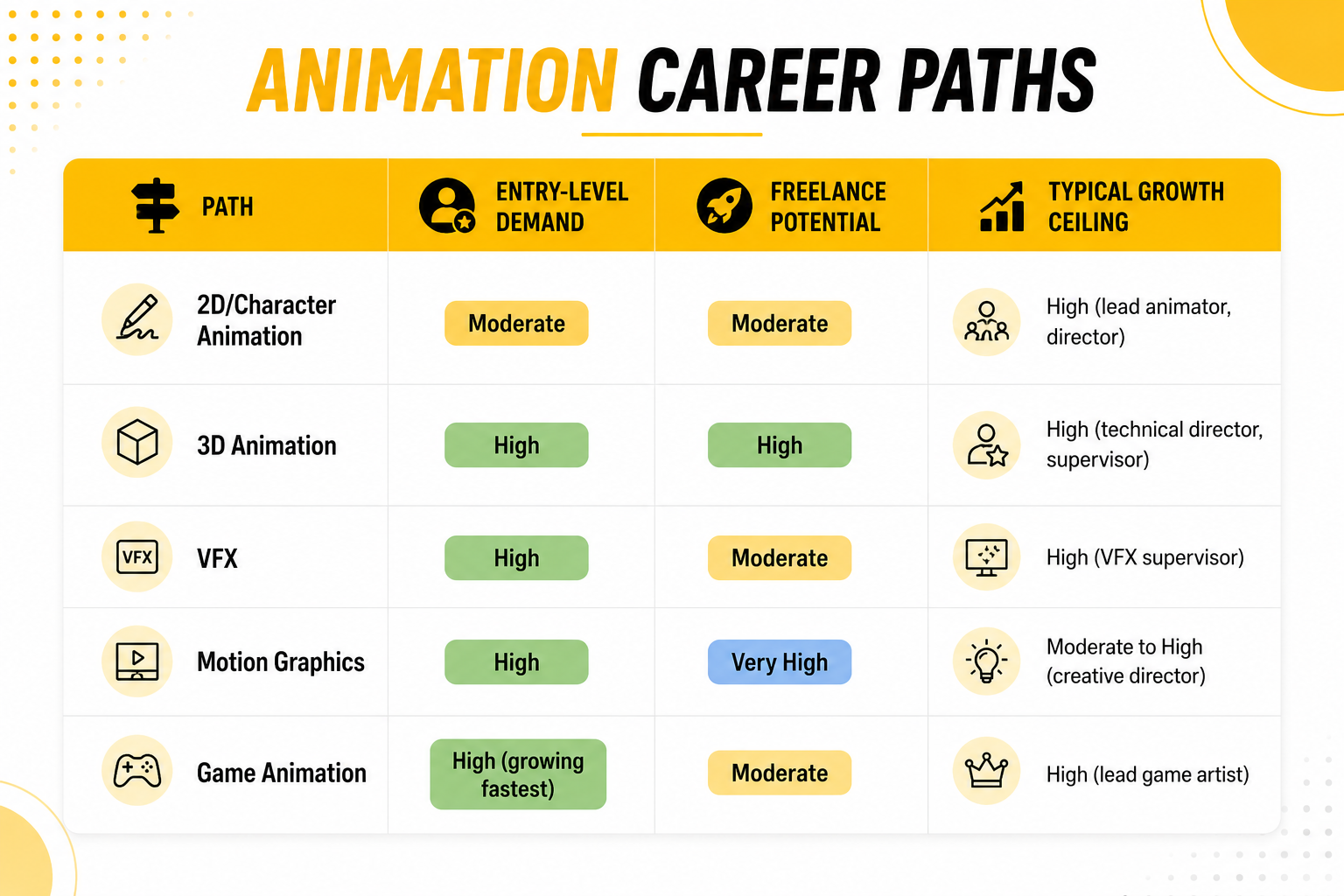
Game animation and motion graphics currently show the fastest-growing demand for freshers in India. This is mostly because mobile gaming and short-form video content have grown faster than traditional film and broadcast animation.
Find the Right Animation Course
Compare 2D Animation, 3D Animation, VFX, Motion Graphics, and Character Animation programs to discover the perfect learning path.
Career Roadmap After an Animation Course
Most guides stop at "here are the jobs that exist." What actually helps is knowing what to do at each stage to land one of those jobs. This is where most students waste time they didn't need to.
Stage 1: Learning the Fundamentals & Building Your Portfolio
In your first year (or first half, for shorter courses), focus on the basics: timing, anatomy, and software skills. Don't rush into a specialisation yet. This is also when you should start a portfolio folder, even if the work isn't good enough for a job yet. Redo your best class assignments in your own time. The version you submit for grading is rarely your strongest one.
Stage 2: Internships, Demo Reel & Choosing a Specialisation
In your final year (or final months), two things should happen together: applying for internships, and narrowing down from "animation" in general to one specific path, such as 3D character animation, VFX compositing, motion graphics, or game animation. Trying to stay a generalist all the way to graduation usually leads to a weaker, less focused demo reel. This can hurt you more than help you in interviews.
Stage 3: Starting Your Career in Junior Animation Roles
In the first 1-3 years in the industry, you are normally working in junior positions like junior animator, junior compositor, layout artist, or rigging artist under a lead or supervisor. This is about speed and consistency. Here, delivering a useable product reliably, on tight schedules, is more important than creative novelty. Specialisation and creative flexibility usually come later, when you have developed a reputation for being reliable.
Animation Salaries in India
In the first 1-3 years in the industry, you are normally working in junior positions like junior animator, junior compositor, layout artist or rigging artist under a lead or supervisor. This is about speed and consistency. Here, delivering a useable product reliably, on tight schedules, is more important than creative novelty. Specialisation and creative flexibility usually come later, when you have developed a reputation for being reliable.
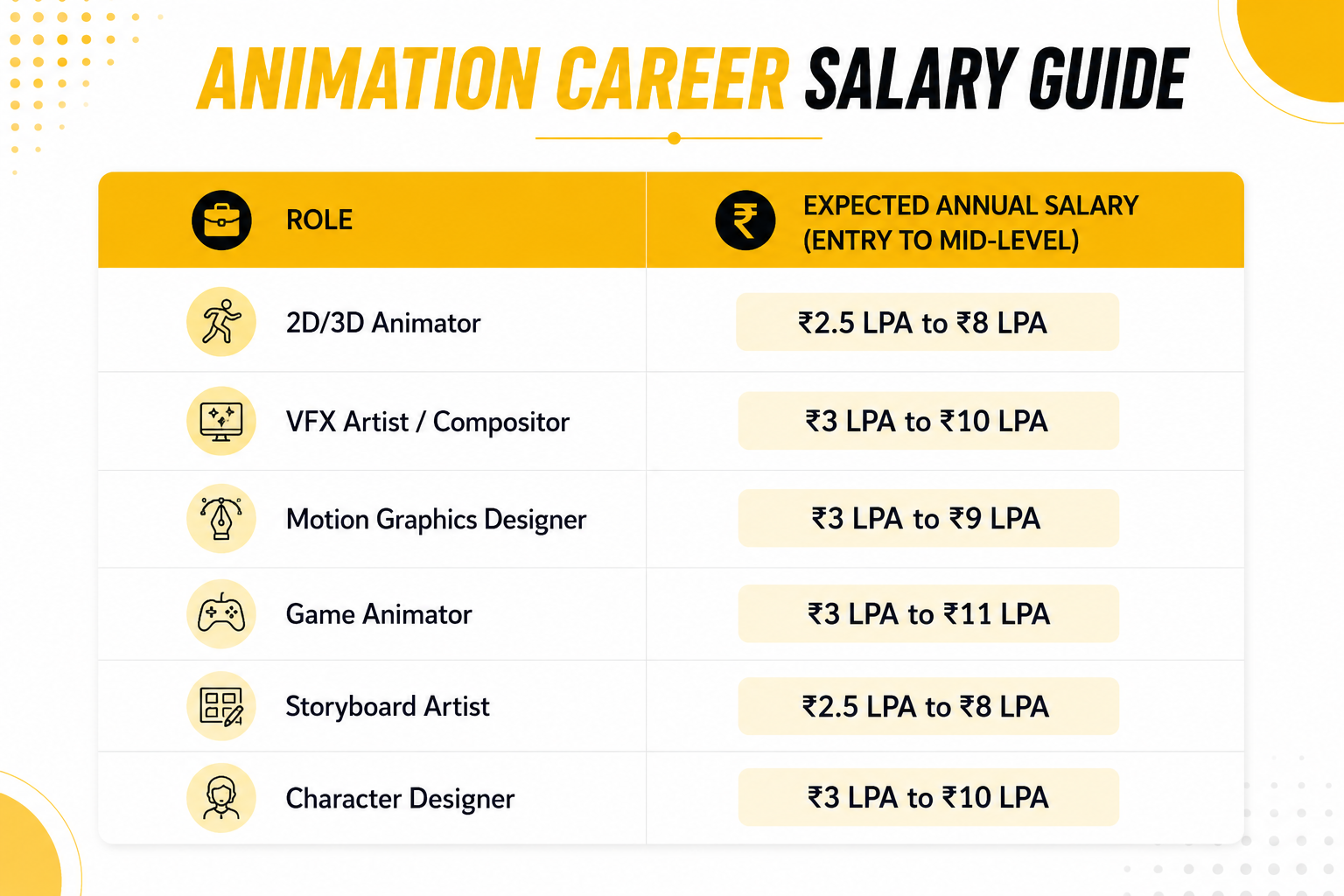
Salary by Specialisation
Here is the estimated salary that you can expect while applying for a job role based on your specialisations:
Salary by Experience Level
Entry-level animators (0-2 years of experience) can expect to earn somewhere between ₹2.5 lakhs and ₹5 lakhs per annum, which will depend on the studio size and the city. At this stage, the income from freelance work is relatively low, which can be compensated by the completion of a few small projects.
Mid-level animators (3-6 years of experience) make about ₹6 lakhs to ₹14 lakhs, respectively, and the figure can be even higher for professionals who specialise in a certain field of animation and have created a good demo reel.
Senior animators (over 7 years of experience) such as lead animators, VFX supervisors, or art directors can expect to earn ₹15 lakhs and even more, especially if they work for studios dealing with international projects.
What Actually Determines Your Salary
Your salary in animation depends far less on your college's name than most students think. The biggest factors, roughly in order of importance, are:
Portfolio and reel quality: the single biggest factor in getting hired and in negotiating pay
Specialisation chosen: technical, in-demand skills (rigging, VFX compositing, game animation) usually pay more than generalist roles
City and studio type: Mumbai and Pune VFX studios, and gaming studios in Bengaluru or Hyderabad, generally pay more than smaller regional studios.
Freelance vs full-time: experienced freelancers working with international clients can earn more than full-time studio staff, though with less steady income.
How to Get Hired After an Animation Course
Finishing an animation program is simply the initial step. To land a job in the sector, it is required to have a great portfolio and experience relevant to the position. Additionally, candidates should possess skills that employers will be looking for when hiring someone.
Build a Portfolio That Gets Interviews
Your portfolio matters more than your degree, diploma, or certificate. Studios look at reels before they look at resumes. A strong portfolio should:
Show only 2 to 4 of your best pieces, not everything you've ever made
Be focused on the role you're applying for (don't mix a VFX portfolio with unrelated 2D cartoon work)
Include process shots or breakdowns where possible, so people can see how you built the final piece, not just the result.
Be hosted somewhere easy to find, such as a personal website, ArtStation, or Behance, instead of scattered across social media.
Create a Professional Demo Reel
For animation and VFX roles, a demo reel (a short video, usually 60 to 90 seconds) matters more than a static portfolio. Keep it short, and put your strongest shot right at the start. Recruiters often stop watching after the first 10 to 15 seconds if nothing grabs them. Label each shot briefly (what you did, such as animation, rigging, or compositing), so reviewers know exactly what your contribution was.
Why Internships Matter More Than Your Degree
Internships give you two things a classroom can't: exposure to real production deadlines, and usually your first portfolio pieces that actually look like industry work. Start applying in your final year instead of waiting until after graduation. Studios are usually more open to taking on interns who are still studying than fresh graduates with zero experience. Not all animation internships in India are paid, but an unpaid internship at a good studio can still be worth it for the experience and contacts, as long as you're doing real production work and not just admin tasks.
What Employers Actually Look For
Beyond the portfolio, Indian animation studios and VFX houses usually check for software skills specific to the role: not just general familiarity, but real speed and problem-solving in tools like Maya, Nuke, or Unreal Engine.
Ability to take and use feedback fast: production work involves constant revisions, and this is often tested directly through a small paid or unpaid assignment
Consistency under deadlines: this matters more at the junior level than creative originality does
Basic understanding of the pipeline: knowing how your task affects the next person's work (for example, how a rigger's work affects the animator who comes after them)
How AI Is Changing Animation Careers in India
AI has moved from a buzzword to an everyday part of animation production in India. It's not taking over animators' jobs, but it is changing how certain tasks get done, and what skills studios expect you to bring beyond just software knowledge.
Where AI Is Already Used in the Pipeline
There are various stages within Indian studios where AI tools are being utilised but not replacing animators. The reason behind using AI tools is to speed up a few of the processes rather than replace animators. Some of the uses of AI tools in the studios are AI-assisted rotoscoping in VFX, automated 2-dimensional animation inbetweening, AI-generated textures and backgrounds, and AI-assisted previews that help in drawing the shots before the process of making the animation film properly starts.
Skills AI Can't Replace
AI tools are strongest at repetitive, technical tasks, not at judgment, timing, or storytelling. A few skills stay firmly human, no matter how good the tools get:
Acting and performance in character animation: AI can generate movement, but not reliable comic or emotional timing
Art direction and creative decision-making: choosing style, mood, and visual tone still needs a human eye
Final polish and finishing: turning a technically correct shot into one that actually feels right
Storytelling and pacing: deciding what a scene needs to communicate, not just how it moves
Studios are increasingly valuing animators who can guide and fix AI-assisted work, not just animators who build everything by hand.
Should AI Change the Course You Choose?
Not your specialisation itself, but it should change how you learn within it. Look for courses and institutes that teach AI-assisted workflows alongside traditional techniques, not ones that ignore AI completely. Being comfortable directing and correcting AI-generated work is becoming as important as knowing the software itself, especially in motion graphics and VFX, where AI use is growing the fastest.
How to Choose the Right Animation Course or Institute
Once you understand the landscape, choosing a course comes down to a few practical checks:
Match the course to a specialisation, not just "animation" in general: if you already know you want VFX or game animation, pick a program with a strong track record in that specific area, not a broad, general course
Check portfolio output, not just course prestige: ask how many finished, reel-ready projects students complete during the program, not just how many subjects are taught
Check the software and lab setup: old software licences or shared computer labs with long waiting times will slow down your learning.
Look at real placement results, not just placement claims: ask for names of studios that recent graduates actually joined, not just a percentage number.r
Add up the total cost, not just tuition: software, hardware, and portfolio costs can add 15 to 30 per cent on top of the listed course fee.
For example, institutes such as OREAL World focus on industry-oriented learning through practical assignments, projects, and help to build a professional portfolio. While you choose an institute, try to look beyond the marketing claims. Evaluate the curriculum, mentors, and the quality of the portfolio they help students to create.
Frequently Asked Questions
1. What is an animation course?
An animation course will teach you how to generate motion using drawings, 3D models,s or digital tools. You have to learn the tools (Maya, Blender, or After Effects, for example) and the basic principles of storytelling, pacing, and visual composition.
2. Which animation courses can I join after 12th?
The choice to take after the 12th is diploma courses and undergraduate degrees (BSc in Animation, B.Des in Animation and VFX). They take students from any stream:m arts, commerce, science.
3. Animation - excellent career in India in 2026?
Yes, provided you do a good portfolio along with your course. Demand is booming for film, gaming, advertising, and non-entertainment, but hiring is based on your skills first, not your degree.
4. Animation or VFX, which is better for freshers?
Neither is better per se. VFX tends to have more regimented studio-based entry-level roles. There is more freelance work available in animation, and notably in motion graphics. It depends on whether you want to work inside a big production team or more autonomously.
Ready to Start Your Animation Journey?
Choosing the right animation course is the first step towards building a career in 2D animation, 3D animation, VFX, motion graphics, or game design. Whether you’re looking for an animation course in Noida or Delhi NCR, the right training should not only teach software but also help you build a portfolio, understand industry workflows, and prepare for real production environments.
Explore industry-focused animation programs at OREAL World, designed around practical learning, professional tools, and portfolio development.